
California drivers typically have 24 to 72 hours to report a car accident to their auto insurer, but the exact deadline is set by your individual policy, not state law. Most policies include a “prompt notification” clause, which requires you to contact your insurer as soon as reasonably possible after a collision. Failing to meet this deadline gives your insurer grounds to delay or deny your claim, even if you were not at fault.
When in doubt, call your insurer the same day. Before you do, speaking with an attorney can protect you from saying something that limits your recovery.
If you are unsure where to start, our Sacramento car accident lawyer at J.G. Winter Injury Lawyers can review your policy terms, handle all communication with your insurer, and make sure a reporting delay does not cost you the entitled compensation. Call (844) 734-2626 today to schedule a complimentary consultation.
Key Takeaways
- You typically have 24 to 72 hours to report a car accident to your insurer in most California policies, but your exact deadline is set by your policy’s “prompt notification” clause, not state law.
- Reporting an accident and filing a claim are two different steps. Failing to report on time can result in claim denial even if you file within California’s 2-year statute of limitations.
- Late reporting gives your insurer legal grounds to deny your claim under the policy’s notice clause, even if the accident was not your fault.
- You are legally required to report accidents involving injury, death, or property damage of $1,000 or more to law enforcement within 24 hours and to the DMV within 10 days using Form SR-1.
- Even minor accidents should be reported. Symptoms like whiplash and soft tissue injuries often appear hours or days after the collision.
- Speaking with a car accident attorney near you before contacting your insurer protects your statement from being used to limit or deny your recovery.
When do you have to report a car accident to insurance in California?
After a collision, contact your insurance company as soon as possible. How soon you need to report a car accident to your insurance depends on your policy, but waiting too long often causes delays or limits access to benefits.
What is the standard reporting window?
Most California insurers use a 24 to 72-hour notice window. This allows adjusters to evaluate the claim while the evidence is fresh and the liability is clear. However, don’t wait for your insurance agent to call you back before taking action.
The only way to ensure your car accident report is based on facts rather than memory is to follow a strict checklist of what to do after a car accident, including documenting the scene and securing witness statements.
How reporting delays can affect your claim’s validity
Delaying notification can weaken your auto insurance claim. Most policies require notice within a short time, often described as “prompt” or “reasonable.” Failing to meet this condition can lead to reduced compensation or complete denial.
Here are 5 legal and financial consequences of reporting late:
- Policy violation and claim denial: Most insurance agreements include a notice clause. A delayed report may be treated as a breach of contract.
Example: A driver waits 10 days to report minor damage. The insurer denies the claim due to untimely notice. - Loss of critical evidence: Delays reduce the chances of collecting documentation such as police reports, medical records, or witness statements.
Example: A claimant cannot obtain timely medical proof of injuries, weakening their case and payout. - Insurer may allege non-cooperation: Insurers can argue that late reporting violates your duty to cooperate.
Example: An adjuster struggles to verify key details, resulting in a lower settlement offer. - Suspicion of fraud or exaggeration: Gaps in time raise doubts about the causes of injury or the severity of damage.
Example: A passenger reports injuries two weeks later; the insurer questions causation. - Delays in receiving key benefits: Late reporting can postpone rental coverage, repairs, or medical payments.
Example: A policyholder misses out on rental reimbursement because the claim was filed after the deadline.
Is there a legal deadline to report a car accident to your insurer in California?
California law does not require you to notify your insurer by a specific deadline. Most insurance policies do, often requiring notice within 72 hours. That means your actual reporting deadline depends on your contract, not state law. Separate rules apply when reporting the crash to the DMV or police.
California insurance code vs. individual policy terms
Your insurance notice deadline and statute of limitations are two separate requirements.
- Policy notice clause: Usually requires you to report the crash to your insurer within 24 to 72 hours.
- Personal injury statute of limitations: California gives you 2 years from the accident date to file a personal injury claim.
- Property damage statute of limitations: California gives you 3 years from the accident date to file a lawsuit for vehicle damage or property loss. Both are separate from your insurer’s reporting requirement.
Failing to meet either deadline can reduce or eliminate your ability to recover damages. Early action protects both your contractual rights and legal claims.
How California’s at-fault rules impact reporting timelines
In California, determining who is at fault in a car accident relies on the state’s pure comparative fault system. Each party involved is assigned a percentage of blame, and your compensation is reduced by your share of the fault. Insurers need timely reports to accurately evaluate these details, which is why reporting the accident early is critical. Waiting too long can result in lost evidence, unclear facts, or disputed claims—all of which may shift more liability onto you and reduce your payout.
That’s why, in any California car accident claim involving comparative fault, reporting without delay is key to protecting your rights and financial recovery.
Should you report minor accidents to your insurance in California?
Many drivers think they do not need to report a minor accident, especially if no one seems hurt. But even low-impact collisions can result in hidden vehicle damage or delayed injury claims. In most situations, notifying your insurer protects your ability to file a valid claim. The next sections explain why.
Why small crashes can still lead to injury claims
Some injuries may not be apparent immediately after a minor accident. It is common for symptoms like whiplash, soft tissue strain, or concussion-related headaches to appear hours or even days later. What initially feels minor can develop into a medical issue as adrenaline fades. Reporting the incident early and creating a record protects your ability to file a claim if symptoms appear.
Having an initial report on file often makes the difference between a valid recovery and a denied claim.
What happens if both drivers agree not to report?
The clearest case where skipping a report may be acceptable: you are the only vehicle involved, no one was injured, and total property damage is under $1,000. In every other situation, even if both drivers agree at the scene to handle it privately, you should report the accident to your insurer. Verbal agreements between drivers are not binding on insurance companies, and the other driver can change their position at any time.
Even if both parties agree not to report an accident, that decision can work against you. Here is why skipping official notifications increases your legal and financial risk:
- No official record means no protection: Without a claim or police report, there is no proof that the accident occurred. Example: Days later, the other driver alleges you caused the damage. With no documentation, it becomes your word against theirs.
- Verbal agreements do not override policy terms: Most insurance contracts require timely notice. Example: You agree not to report, but the other driver later files a claim. Your insurer denies coverage due to late notice.
- Delayed injuries or damage may surface: What seems minor at first may involve medical issues or costly repairs. Example: You feel fine at the scene but develop neck pain three days later. Without a report on file, your claim can be disputed.
- You could violate your insurance policy: Failing to report could breach your contract, even if you were not at fault. Example: Your insurer learns of the crash from the other party’s claim and penalizes you for non-disclosure.
If you are thinking of not reporting an accident, know that it increases the risk of claim denial, policy disputes, and legal exposure.
What to include when reporting a car accident to your insurance
When reporting a car accident to your insurance company, you need to include specific, fact-based details. Clear and complete information supports your claim and helps prevent delays or disputes.
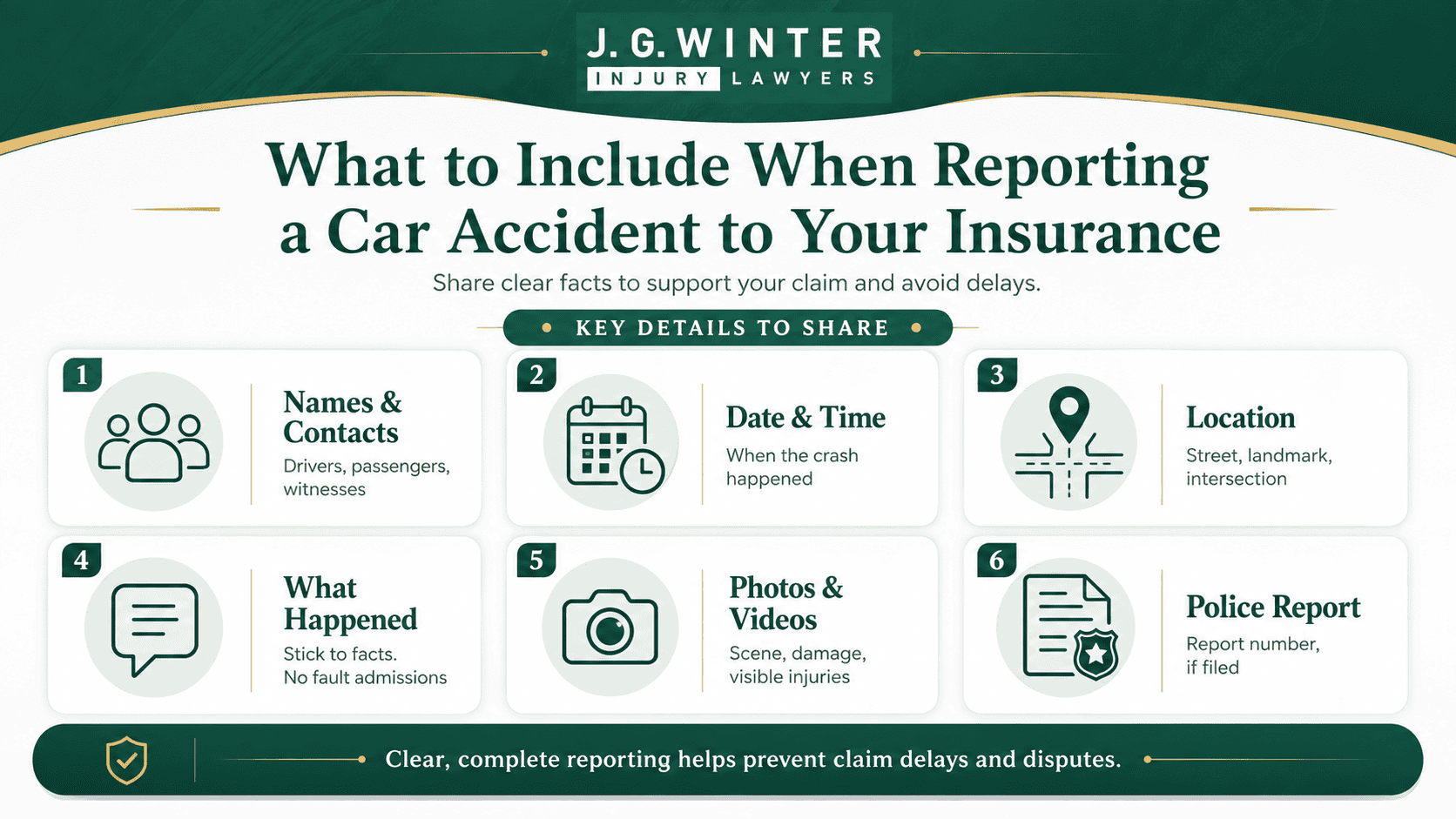
Key details to share: who, when, where, what
When you contact your insurance company after an accident, include these six key details:
- Names and contact info of all drivers, passengers, and witnesses.
- Date and time the accident occurred.
- Exact location of the crash (street names, landmarks, intersections).
- A clear description of what happened, sticking to facts without admitting fault.
- Photos or videos of the scene, damage, and any visible injuries.
- Police report number, if a report was filed.
Common mistakes to avoid when talking to insurance
Knowing what not to say to an insurance adjuster after an accident is just as important as knowing what to include.
Avoid these 5 common mistakes to preserve your claim:
- Do not admit fault: Even a casual “I am sorry” can be interpreted as accepting legal responsibility. Let the investigation determine liability.
- Do not speculate about injuries: If you are unsure whether you are hurt, say so, do not guess. Symptoms often appear hours or days later.
- Do not downplay the damage: Avoid calling the crash “minor.” What seems small could require costly repairs.
- Do not give inconsistent statements: Stick to one version of events when speaking with your insurer, police, or other parties.
- Do not provide recorded statements without legal guidance: You have the right to decline a recorded statement until you have consulted an attorney.
What happens if you miss the insurance reporting deadline?
Failing to report a car accident within your insurer’s required timeframe does not automatically void your claim, but it can create serious coverage issues. Insurers may allege that the delay violated the policy’s notice clause, impacted their ability to investigate, or prejudiced their legal defense. These disputes often lead to reduced payouts or complete denial of benefits.
How insurers use late reporting to deny claims
Most auto insurance policies contain a “prompt notice” provision, which requires you to notify the insurer of a claim within a reasonable time. If notice is delayed, insurers may argue that a material breach of contract or failure to cooperate has occurred, especially when critical evidence, such as medical records, photos, or eyewitness accounts, has been compromised.
Example: If another party files a liability claim and your insurer did not receive timely notice, they may decline to provide a defense, leaving you exposed to out-of-pocket legal costs.
Even honest mistakes in timing are frequently cited as grounds for claim denial under breach or prejudice doctrines.
Can you still file an insurance claim after missing the deadline in California?
Yes, you can still pursue a claim even after a late report. However the delay has to be reasonable and did not materially prejudice the insurer. Under California insurance law, coverage may still be available unless the insurer proves that the delay impaired their ability to investigate or defend the claim.
California courts often apply the notice-prejudice rule, meaning a delay alone is not enough to deny benefits unless the insurer can show actual harm from the delay.
If your claim has been denied based on timing, consulting a car accident attorney is critical. Legal counsel can help establish good cause, challenge bad faith denial, and preserve your right to compensation.
Does prompt insurance notification improve your injury claim?
Prompt reporting strengthens the foundation of a personal injury claim. It creates a time-stamped record, supports how liability is assessed, and helps verify key facts like injuries or damages in dispute.
How timely reporting preserves evidence and claim value
Reporting quickly helps secure time-sensitive proof, like scene photos, road debris, and initial medical evaluations that may be lost or contested later. It also improves the accuracy of statements from witnesses and first responders. These early details can directly influence how your insurer values your claim.
When to contact a lawyer if the insurance company delays or denies
If your insurer delays or denies your claim, a car accident lawyer can step in to review your coverage terms, dispute the decision, and represent you in any negotiations or appeals. Early notice strengthens your legal position by showing that you followed policy requirements and documented the claim process clearly.
Are you legally required to report a car accident to the police in California?
Yes, under California law, you must report a car accident to the police if it causes injury, death, or property damage of $1,000 or more. This legal requirement is separate from your insurance duties.
When police reports are mandatory under California law?
You are required to report to law enforcement under California Vehicle Code §16000 in cases involving injuries, fatalities, or significant property damage. Failure to report an accident involving injuries or death carries penalties under California Vehicle Code §20001, including fines of up to $10,000 and potential imprisonment of up to one year. You must also file Form SR-1 with the DMV within 10 days, even if a police report was filed. Failing to do so may result in license suspension or complications with insurance.
How police reports can support your insurance claim
A police report gives insurers an impartial summary of what happened, including road conditions, injuries, and vehicle damage. If the other party later disputes liability or changes their version of events, this document helps validate your account and protect your claim.
What if the other driver does not report the crash?
If the other driver fails to report the crash, your ability to recover damages depend on your available coverage. That is why you should report the accident to your insurer immediately, even if the other party promises to handle it privately.
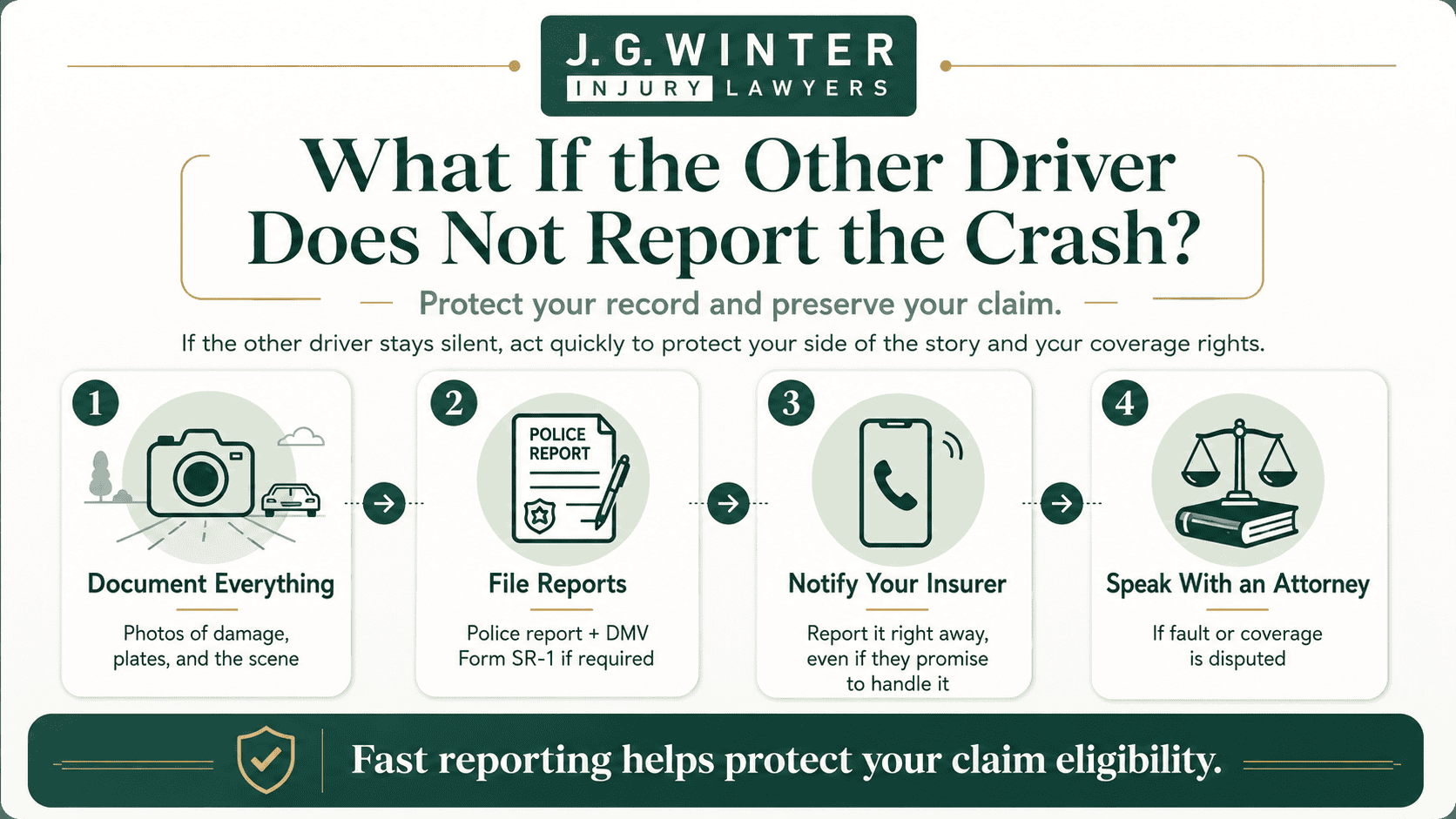
If the other party stays silent, take these four steps to protect your side of the record and maintain your claim eligibility:
- First, document everything. Take photos of the damage, license plates, and the scene.
- Second, file a police report and submit DMV Form SR-1 within 10 days if required.
- Third, notify your insurer right away, even if the other driver claims they will handle it.
- Fourth, speak with a car accident attorney if there is a coverage dispute or fault is being contested.
Can uninsured motorist coverage help in these situations?
Yes. In California, uninsured motorist (UM) coverage may apply if the other driver refuses to report the accident, gives false information, or leaves the scene. Insurers often treat this as a hit-and-run. To access UM benefits, report the incident quickly and document the scene with photos, including witness details and license plate information.
What is the deadline to file a personal injury claim after a car accident in California?
In California, the legal deadline to file a personal injury claim, known as the statute of limitations, is 2 years from the date of the accident. If you miss this window, your case will likely be dismissed, even if your injuries are serious.
Statute of limitations for personal injury vs. insurance notification rules
The 2 year statute of limitations applies to filing a lawsuit, while insurance policies usually require you to notify the insurer within 24 to 72 hours. One protects your right to sue; the other affects your claim’s handling. Failing either can reduce or block your recovery.
Why missing the legal deadline can end your case
California courts enforce the statute of limitations strictly. Once the 2 year window closes, your case is barred. Even delays within the deadline can hurt your position in negotiations and give insurers a reason to dispute your claim. Early legal action improves your chances of recovering full damages.
Speak with a California car accident lawyer today
Delays in reporting and disputed coverage decisions are among the most damaging and preventable problems in California car accident claims. Attorney Jeremy Winter has recovered over $1.5 million for car accident victims in Northern California, including clients whose claims were initially disputed by their own insurers over timing and notice issues.
At the Law Offices of J.G. Winter, we serve injured drivers throughout Sacramento, Folsom, Stockton, and the surrounding Northern California communities. We review your policy terms, challenge bad faith denials, and handle all insurer communication so you can focus on your recovery. Contact us today for a free consultation. No obligation. No fee unless we win.
¿Hablas español? Visita Mereces Jeremias para asistencia en español.