In a California car accident, the location of damage on each vehicle is one of the most reliable pieces of physical evidence available to investigators, adjusters, and attorneys. Dents, crush patterns, paint transfer, and point-of-impact zones do not lie. They reconstruct what happened even when driver accounts conflict.
Fault in California is not decided by who speaks first, who appears more distressed, or which vehicle looks worse overall. It is determined by physical evidence, California Vehicle Code violations, and the state’s pure comparative fault system, which assigns each driver a percentage of responsibility that directly reduces their compensation.
At J.G. Winter Injury Lawyers, attorney Jeremy Winter has helped injured drivers throughout Sacramento, Folsom, and Stockton challenge incorrect fault assignments backed by damage analysis and independent crash reconstruction. If an insurer or another driver is disputing your version of events, the physical evidence on your vehicle may be your strongest argument.
Call (844) 734-2626 and schedule a free case review with a highly experienced car accident attorney in Sacramento.
Key Takeaways
- The location and extent of vehicle damage can help investigators reconstruct how a California car accident occurred, but damage alone doesn’t automatically determine fault.
- Different damage patterns, such as those from rear-end, side-impact, head-on, and corner collisions, often suggest different collision types and point to which driver was likely at fault for making an unsafe move.
- California follows a pure comparative fault system, so the parties divide fault by percentage, and the court reduces your compensation by your share of responsibility.
- Police reports, photos of the damage, repair estimates, scene diagrams, and crash reconstruction evidence all play a role when fault is in dispute.
- Insurance adjusters make fault assessments on behalf of the insurer, and those conclusions can be challenged with independent evidence and expert analysis.
- If you were injured in a crash, document the scene, preserve your vehicle’s damage, and speak with a Sacramento auto accident attorney before accepting fault or settling.
Why the location of damage matters in car accidents?
The location of damage on a vehicle provides objective, physical evidence in a car accident investigation. This evidence helps reconstruct the moments leading to the crash. It indicates the direction of force, points of impact, and relative speeds. Understanding these elements is fundamental to assigning fault correctly under California law. This knowledge empowers you to protect your rights.
.
How damage location in car helps identify fault?
The location of damage on a vehicle provides objective physical evidence that investigators use to reconstruct the moments before, during, and after a crash. Unlike driver statements, which are often inconsistent or self-serving, damage patterns indicate the direction of force, the point of first contact, and the approximate speed and angle of impact. These elements are fundamental to assigning fault correctly under California law.
The location and extent of vehicle damage can qualify as relevant evidence in a fault dispute under California Evidence Code 210, because it tends to prove or disprove how the collision occurred. Insurance adjusters, police officers, and California courts may all rely on this physical evidence when driver accounts are inconsistent or conflicting.
Legal and insurance implications of damage patterns
Photos and repair records are essential evidence used to prove fault in California courts. The nature and extent of damage directly influence insurance claim valuations. They also play a role in determining percentages of fault under California’s comparative negligence system.
Visible damage does not always reflect the full impact. Internal or structural damage often reveals the true force and responsibility in a crash. Our attorneys meticulously interpret damage patterns, we use this information to build a strong defense for our clients, and work to ensure fault is assigned correctly. If your insurer disputes your version, call our Sacramento car accident lawyers for a free claim review.
The process of fault determination in California car accidents
Determining fault after a car accident in California involves multiple parties, timelines, and types of evidence. Knowing this process helps you handle your claim with greater success. These findings directly impact your car accident compensation eligibility. We make this process fair for you.
How fault is determined and who decides it under California law?
California follows a ‘pure comparative fault’ rule. You still recover damages even if you were partially at fault, but your recovery is reduced by your percentage of fault. An experienced Sacramento car accident lawyer is crucial in such disputed cases.
What evidence is used to establish fault?
Various forms of evidence establish fault. Key types include:
- Photographs and videos: Document the accident scene and vehicle damage.
- Dashcam footage: Records the accident sequence from a vehicle’s perspective.
- Eyewitness testimony: Offers neutral accounts supporting your claim.
- Expert damage evaluations: Detail vehicle damage and impact specifics.
- Electronic data: Includes GPS, EDR, and surveillance footage, providing precise vehicle information.
The role of statements, diagrams, and scene documentation
Accurate reports and extensive scene documentation are necessary. Accident sequences are described using scene sketches. Your police and insurer statement accounts for the accident; it must be accurate and consistent. Avoid admitting fault or guessing, as this will weaken and possibly destroy your case. Early, detailed reporting preserves evidence and leads to more effective cases.
How damage location is interpreted in real-world collision scenarios?
Damage location interpretation is a practical science. The collision type plus damage location creates an initial fault assumption. For instance, rear damage on one vehicle and front damage on another normally suggests a rear-end collision. Investigators look for paint transfer, impact angle and depth, and debris patterns. First impressions are often misleading. A crash reconstructionist confirms or disproves assumptions through the scientific method and deductive reasoning.
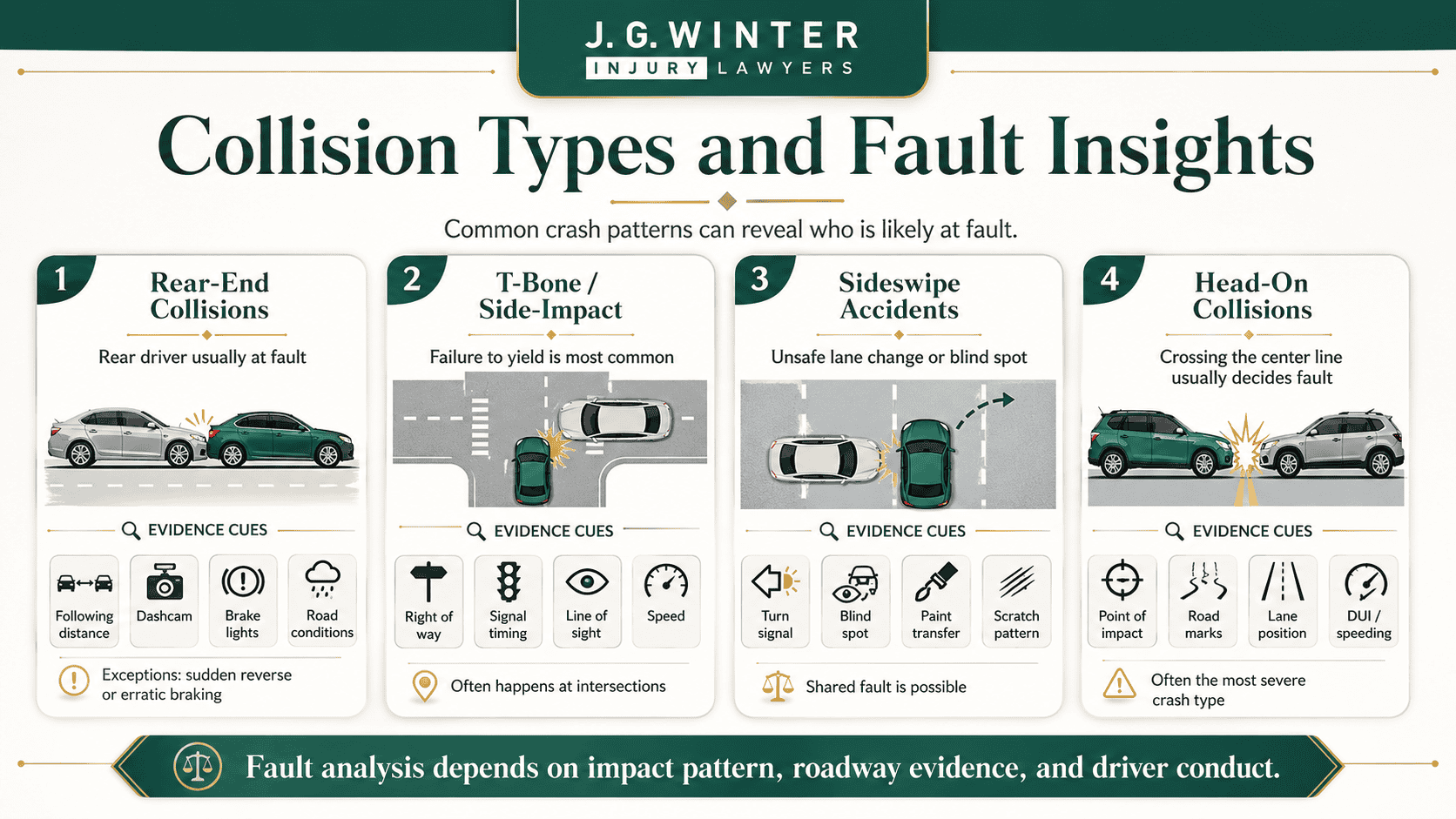
Collision types and fault insights
Car accident type reveals highly predictable fault patterns. These known patterns, which are well recognized by traffic and criminal courts in Sacramento County and other Northern California counties, help explain crash dynamics.
Rear-end collisions and fault
California law presumes the rear driver is at fault in most rear-end collisions. This is because drivers in California are expected to maintain a proper following distance. The rear driver is typically presumed to be at fault for failing to meet this requirement.
The leading driver is sometimes found to be in error. Sudden reversing or irregular braking by the front vehicle, or a faulty brake light, are exceptions. Road conditions, distractions, or mechanical failure are environmental factors. Dashcam footage often provides clear evidence, perhaps supplanting initial assumptions about fault in the car accident.
Side-impact collisions (T-bones)
Side-impact or T-bone accidents usually occur at intersections when drivers do not use the right-of-way. Side-impact collisions include running red lights, stop signs, or incorrect estimation of left turns. The driver who did not yield is most commonly the one to blame.
The driver’s line of sight and speed affect responsibility. Restricted views or high speeds reduce reaction time. Signal timing and sign placement play a role, especially if obstructed or malfunctioning. Examiners take door intrusion/incursion and severity of injury into account when making impact force judgments.
Sideswipe accidents and fault analysis
Sideswipes occur when moving vehicles in the same or opposite direction collide with one another on the side. The usual causes are unsafe lane changes, failure to check blind spots, improper merging, and distracted driving.
Use of turn signal or its absence is the most telling evidence. Not signaling shows driver negligence. Both drivers are generally to blame in sideswipe accident incidents, especially if both were moving or attempting to occupy the same space on the road. Investigators trace fault using paint transfer and scratch patterns.
Head-on collisions and damage clues
Head-on collisions are usually the most serious of collision types. The point of impact helps determine which vehicle left its lane and traveled across the center line. The vehicle that crosses the wrong lane is almost always at fault. Fault is confirmed using point-of-impact and road marks.
Damage evaluation considers crumple zones that distribute impact. The level of deformation indicates the magnitude of forces levied on vehicle occupants. Driver inattention, which DUI, speeding, or texting may cause, is a leading cause of head-on crashes and explicitly establishes fault.
What is the most common type of car accident where fault is determined by damage location?
Statistically, rear-end collisions happen most often, and fault is typically more apparent because following drivers must maintain a safe distance.
Fault analysis and investigative techniques
Professionals use systematic methods beyond the capabilities of the average person to analyze fault from vehicle damage. They combine physical evidence examination, digital data retrieval, and testimonial analysis with their own historical experience. Our firm uses each of these techniques to draw expert conclusions that withstand legal scrutiny in Sacramento area county courts.
Role of California law enforcement in fault analysis
California law enforcement has first responder duty consisting of multiple critical tasks. On-scene officers (e.g. Sacramento Police, CHP) first ensure safety of all accident vehicle occupants, then document damage, interview individuals, and note environmental conditions. These observations become an official opinion reported on in a Traffic Collision Report, accompanied by a diagram and a brief assessment regarding the primary collision factor.
These reports have no legal impact on civil liability. The officers’ opinions can be contradicted by further evidence. Issued citations impact liability findings.
Tools and technology used to analyze fault based on damage
Advanced technology provides four great tools:
- Crash data retrieval (CDR) systems: “Black boxes” capture speed, braking, and steering before, during, and after a crash.
- Drone video and 3D surveying: Laser scanning and drones produce precise scene diagrams, capturing vehicle positions and wreckage.
- Telematics and sensor data from vehicles: Modern vehicles capture driving patterns, location, and performance data.
- Forensic software: Scenarios are influenced by models, evaluating dynamics based on damage, EDR information, and scene evidence.
How investigators interpret impact angles and visible damage?
Examiners thoroughly examine impact angles and superficial damage. The impact angle helps to establish direction and relative velocity. Crush profiles (deformation patterns) indicate the direction and magnitude of force. They equate impact marks with statements and car resting positions. Angle and position are more important than surface damage.
The role of crash reconstruction experts
Crash reconstructionists use training in physics and engineering to scientifically explain how an accident happened. Their reports influence insurance and legal outcomes. These experts scientifically analyze skid marks, debris, and impact zones to reconstruct events. You or your Sacramento car accident lawyer should hire a credentialed local crash reconstruction expert if fault is disputed or injuries are serious, as their official inputs will greatly strengthen the other evidence in your case.
Legal and financial implications of fault
Fault determination has significant legal and financial consequences. It impacts your compensation for injuries and losses, insurance claims, and future premiums.
Vehicle damage and insurance claims
Insurers examine and record auto damages through photos and estimates. Damage type, severity, and location influence repair or replacement payments. The insurer of the party at fault usually pays these bills in full if their client’s coverage is adequate. Independent repair shops often provide third-party estimates used to dispute insurer valuations. If your insurer underestimates the repair cost, you have the right to dispute it. Our team at J.G. Winter Law is well versed in how to ensure the damage valuation reflects your rightful compensation.
How fault percentage affects your compensation in California?
California’s pure comparative fault system means your compensation is reduced by your assigned percentage of fault. For example, if you are found 20 percent at fault for a collision resulting in $100,000 in damages, you recover $80,000. If you are found 40 percent at fault, you recover $60,000. You are still entitled to compensation even if you bear a majority of fault, though recovery at high fault percentages is rarely worth pursuing without significant damages.
Fault percentage is not a fixed finding; it is a negotiated or litigated position. Insurers set their initial percentage based on their adjuster’s assessment. That assessment can be disputed using independent damage analysis, expert reconstruction, and evidence that was not available to the adjuster at the time of their evaluation.
What happens if I’m at fault in a car accident in California?
Fault percentage directly determines the value of a personal injury claim in California. Under pure comparative fault laws, your award is reduced by your fault percentage. You are 20% at fault for $100,000 in damages, you will be awarded $80,000. You are still compensated even if partially at fault. We develop strategies to minimize your fault share and maximize compensation.
Fault and its impact on insurance premiums
An at-fault collision typically increases auto insurance premiums, and in the aftermath, your insurers will recompute your risk assessment and likely raise your rates. Insurance rate increases typically last between 36 and 60 months, depending on your provider and record; some policies do offer “accident forgiveness” under certain conditions. Winning an appeal of a wrongful fault assignment can stop or reverse a rate increase.
Addressing fault disputes after a crash
Fault disagreements over who is at fault in a car accident are common. The other driver almost always has a different story, or insurers unfairly assign blame. Understanding that disputes occur is key, but know that an incorrect fault determination will significantly impact you. We are here to help get to the bottom of things and uncover the truth.
Steps to take if you disagree with a fault determination
If you disagree with an insurer’s fault determination, write and notify them officially. In preparation for your dispute:
- Collect evidence: Obtain reports, photos, and witness statements.
- Request review: Have your insurer re-examine with fresh evidence.
- Consult with specialists: Discuss your individual situation with a car accident attorney at The Law Offices of J.G. Winter, to obtain specialized case assessment and guidance.
Request a new claims adjuster or file for third-party arbitration to resolve the dispute. Fresh evidence matters, and legal help certified by the State Bar of CA improves dispute success.
Legal options for disputing fault in car accidents
Legal options include mediation (third-party neutral) or a hearing where a neutral person makes the final decision. A personal injury lawsuit allows a judge or jury to determine fault. Note California’s 2-year statute of limitations for injury lawsuits for injury lawsuits. Our staff at J.G. Winter Law will file comprehensive claims and represent you at all phases of the procedure.
Who determines fault in a car accident?
Multiple parties contribute to fault determination: police, insurance adjusters, and courts, if a lawsuit occurs. Police offer an initial assessment. Insurers investigate for claim handling. Each party may reach a different conclusion based on their own internal investigation. Obviously, the decision of the Sacramento county superior court of jurisdiction holds most legal weight. An attorney’s investigation often uncovers evidence overriding earlier findings.
Common myths about fault and damage location
Misconceptions about fault and vehicle damage are common. “More damage means more fault” or “police reports are final” are often inaccurate. Believing these myths can negatively impact your claim and liability. Question all assumptions, because false beliefs can be costly.
Is the car with more damage always at fault?
No. Sometimes, the car with less visible damage caused the crash. Internal vehicle damage or collision dynamics often tell a different story.
Can fault be determined solely by damage?
No, fault cannot be determined solely by vehicle damage. Additional pieces of evidence, such as witness statements, dashcam footage, and police reports, are often more decisive.
Do insurance companies always agree on fault?
No, insurance companies do not always agree on fault. Each insurer conducts its own investigation, and conclusions often conflict.
What to do after an accident to protect your case?
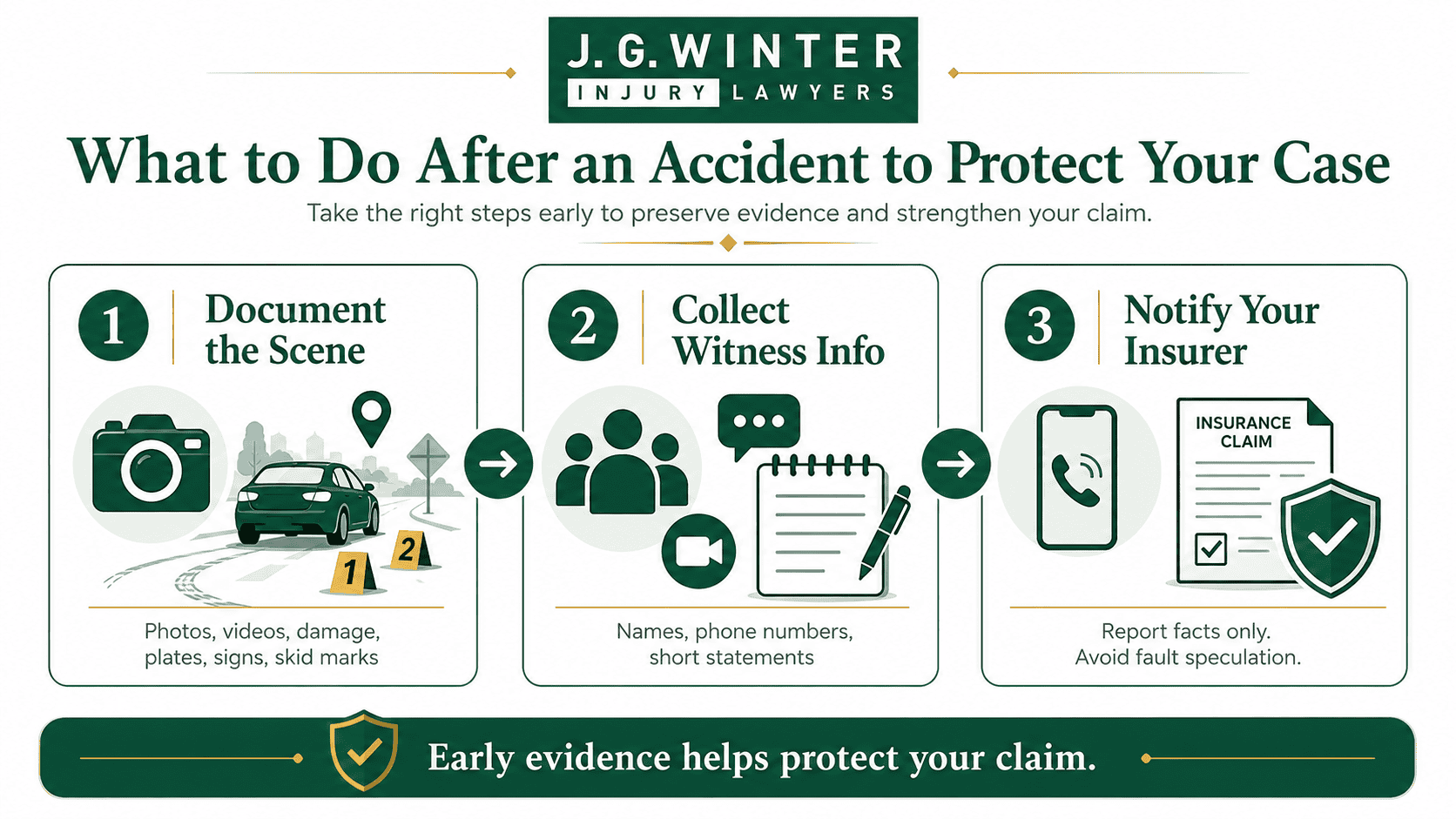
Immediate action makes a big difference. Here is what to do after a California car crash to build your case from day one.
Document damage and the scene
Carefully record damage to vehicles and the surrounding area of the incident. Photographs are the most compelling proof. Take dozens of photos and videos: general shots, close shots of damage from different angles, license plates, street signs, skid marks. Put timestamps and geolocation into your photographs, if possible. This is extremely useful to investigators and insurance companies for validating your claim arguments.
Collect witness statements
Witness statements are impartial accounts. Politely ask for contact information and whether they are willing to give a short statement summarizing what they saw Third-party, unbiased accounts add significant credibility to your version of events. Get a short video statement (with their permission) or a signed written statement. Get their name, phone number, and address.
Report the accident to your insurer
Inform your insurer of the accident promptly, as California law and your policy demand. Report objective facts: date, time, location, parties. Stick to facts known; avoid speculating on fault or injuries. It is highly recommended to contact a lawyer before giving detailed statements to any insurer, especially the other driver’s.
Why should you consult a car accident lawyer?
Consultation with an experienced car accident lawyer such as The Law Offices of J.G. Winter is the best way to protect your rights after a Northern California car crash. We are familiar with fault disputes, insurance policy claims, and local court systems.
Our personal injury firm helps you organize and handle evidence collection and resolve fault disputes. An early visit by an attorney preserves all collected evidence and prevents you from unwittingly undermining your own claim. Our expert legal help ensures your rightful compensation is maximized in the end.
Choose the Law Offices of J.G. Winter as your legal help
At The Law Offices of J.G. Winter, we have extensive experience handling complex car accident claims in Sacramento and Northern California. We have a record of recovering positive case results for our clients. Our client-focused policy requires that we prioritize your needs and well-being above all else.
We operate on a “no fee unless we win” basis. This means you do not pay any attorney fees unless and until we win compensation for you. If you were in a Sacramento crash and the fault is unclear, please schedule a free consultation with our local team. We help you clarify damage-based liability and accelerate your physical and financial recovery from the accident. Call us now.