
Folsom Catastrophic Injury Lawyer
A catastrophic injury changes the financial math of a lifetime. Jeremy Winter builds the life care plan that documents every future medical cost, and that document is what separates a fair recovery from one that runs out before the bills do.




Why Hire Our Folsom Catastrophic Injury Lawyer?

Committed to protecting clients' rights and pursuing favorable outcomes through diligent legal representation.

Since 2006, our firm has represented clients across California with dedicated, personalized legal guidance.

Personalized attention, responsive communication, and dedicated legal support from start to finish.

Speak with an experienced attorney at no cost to discuss your legal rights and options.
California does not define “catastrophic injury” in a single statute. Courts, insurers, and medical professionals apply a functional test: will this injury require treatment, equipment, and support for the rest of the person’s life? That question is what separates a catastrophic injury claim from every other case a personal injury attorney handles.
The most important factor in case value is not the severity of the injury. It is whether the attorney can build a credible life care plan: a documented projection of every medical cost, therapy, assistive device, home modification, and support service the injured person will need from today through the end of their life. Without one, insurers routinely undervalue catastrophic claims by hundreds of thousands, sometimes millions, of dollars. With a weak one, they do the same.
At the Law Offices of J.G. Winter, Jeremy Winter handles every catastrophic injury case personally: TBI, spinal cord injuries, paralysis, amputations, severe burns, and multi-organ trauma. He has represented seriously injured clients on the Highway 50 corridor, at Folsom Ranch and Empire Ranch construction sites, and throughout El Dorado and Sacramento counties for 20 years.
With over $100 million recovered for injured Californians and the life care plan resources to document every future cost, our Folsom personal injury lawyer builds the kind of case that gives insurers no room to undervalue a lifelong injury.
Call (916) 702-7870 for a free consultation online or visit our Folsom office at 102 Natoma St, Ste A, Folsom, CA 95630.
Why J.G. Winter for your catastrophic injury cases:
- 20 years of serious injury experience
- $100M+ recovered for injured Californians
- 4.9‑star rating from 146+ verified client reviews
- 100% contingency fee: no attorney fee unless compensation is recovered
- 24/7 availability at (844) 517-0586
- Bilingual English/Spanish: full-service representation in both languages
EXCELLENT Based on 101 reviews
 Posted on Google
 Francisco23 days agoJanet and Sergio were a great help to me; I spoke with them and they will be helping me with my injury. I highly recommend lawyer Jeremias.
(Translated by Google, see original)Posted on Google Oscar Vega25 days agoHi, my name is Oscar. I was in an accident where I was rear-ended, causing injuries. I called 911, but the police never arrived. The other person blamed me. Insurance companies don't usually help much, which is why I went to Jeremias's law firm. They are a great team of professionals. Thank God they helped me, especially Diana Becerra, who was always attentive to my medical appointments and therapy sessions. Thanks to her excellent work, the entire team, and attorney Jeremias, they won my case. I highly recommend them. If you've been in an accident, believe me, they will work professionally for you. You deserve more. You deserve the best. You deserve Jeremias.
(Translated by Google, see original)Posted on Google Flako sanchez28 days agoPosted on Google
 Santi36 days agoVery helpful and kind. Lot of good info. I know who callPosted on Google
 sam_i_am36 days agovery helpful team and good info on event highly recommendPosted on Google
 Mari Hernandez36 days agoA great team, everyone is very friendly. Always willing to answer any question, very helpful.
(Translated by Google, see original)Posted on Google Junior Rodriguez36 days agoGreat law firm, very helpfulPosted on Google
 Lordk4rn4ge36 days agoI meet them and they were really friendly.Posted on Google
 Rebeca Luna36 days agoPosted on Google
 Iveth Bucio36 days agoSergio, Adriana, and Jeanette provided excellent service, giving valuable information at the resource desk.
(Translated by Google, see original)Verified by TrustindexTrustindex verified badge is the Universal Symbol of Trust. Only the greatest companies can get the verified badge who has a review score above 4.5, based on customer reviews over the past 12 months. Read more
What is a catastrophic injury in California?
The functional definition used by courts, medical professionals, and insurers is consistent: an injury qualifies as catastrophic when it permanently limits or eliminates the ability to perform basic activities of daily living, causes permanent impairment to a major body system, or requires ongoing medical management for the remainder of the person’s life.
The practical consequence of that definition is significant. The label “catastrophic” is not assigned at the emergency room. It is determined over time, often months or years after the accident, as the full scope of permanent damage becomes medically established. Evidence gathered in the first weeks after an injury can determine whether permanence can be proven at all, and that window closes fast. Early legal representation protects it.
Injured parties may recover damages for future losses that are reasonably certain to be incurred, meaning a properly documented catastrophic injury claim can include the projected cost of medical care, therapy, and support for decades to come. California’s two-year personal injury statute of limitations interacts directly with how life care plan cases are timed, and catastrophic cases close that window faster than they appear to.
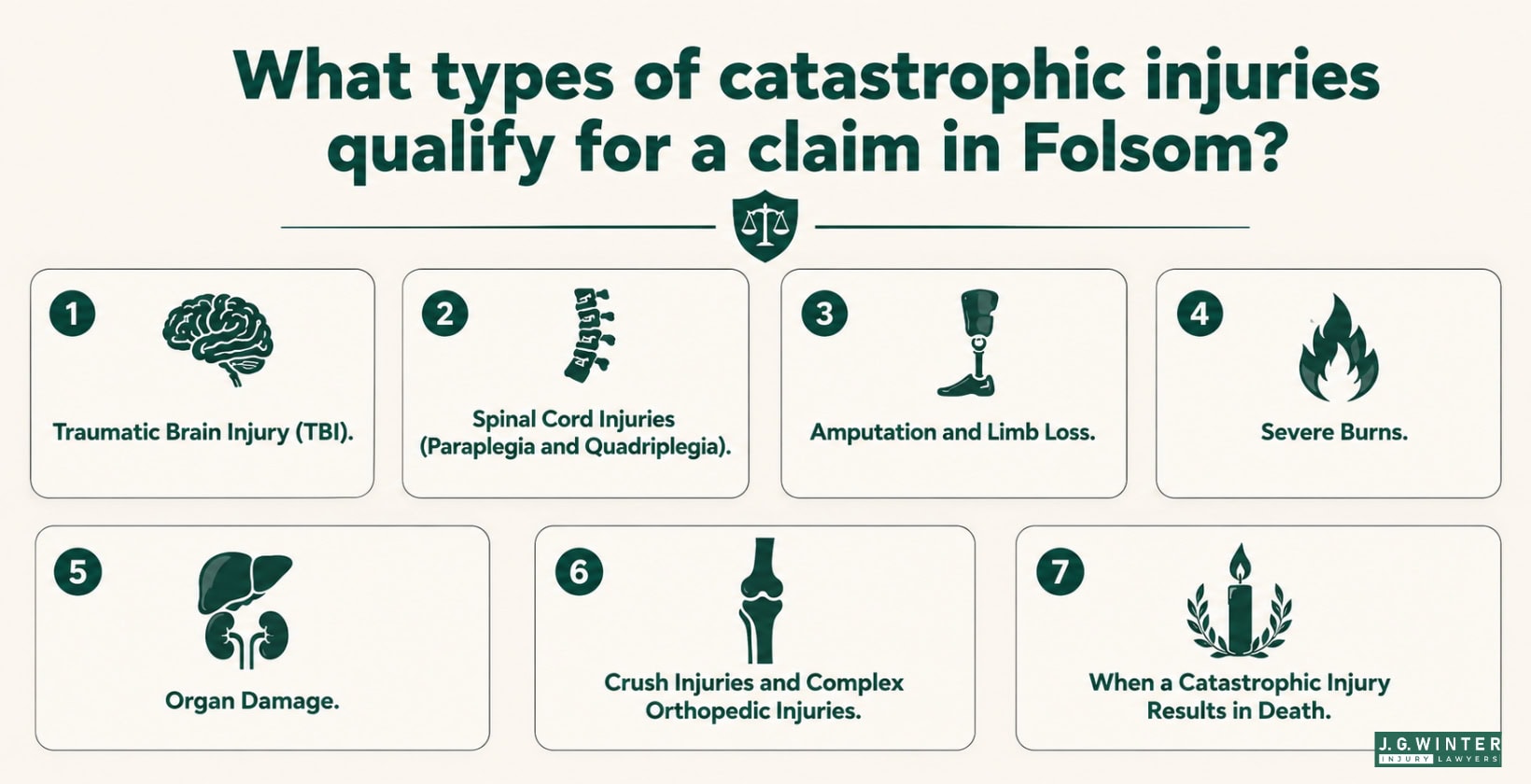
What types of catastrophic injuries qualify for a claim in Folsom?
Catastrophic injuries reach Jeremy’s office through construction sites in Folsom Ranch, collisions on the Highway 50 corridor, workplace accidents throughout Sacramento County, and defective products sold across El Dorado County. The injury type shapes how the case is built, which experts are needed, and what the life care plan must document.
- Traumatic Brain Injury (TBI). A TBI can range from a concussion with prolonged symptoms to a severe injury producing permanent cognitive and physical deficits. Because TBI symptoms are not always visible on initial imaging, insurers frequently challenge their existence and permanence. A Folsom TBI lawyer at our firm works with neurologists and neuropsychologists whose findings stand up under that scrutiny.
- Spinal Cord Injuries (Paraplegia and Quadriplegia). Damage to the spinal cord typically produces some level of permanent impairment, and the lifetime costs of paralysis make spinal cord injuries among the highest-value catastrophic claims. A Folsom paralysis lawyer can explain how these cases are valued and what a life care plan must include for a client facing permanent mobility loss.
- Amputation and Limb Loss. The loss of a limb involves immediate surgical and rehabilitation costs, but the lifetime cost of prosthetics, upgrades, and adaptive equipment can reach seven figures over a 30- or 40-year care horizon. Building that projection accurately requires a credentialed life care planner working from current prosthetic pricing and the client’s specific functional needs.
- Severe Burns. Burn injuries are among the most painful and costly to treat, often requiring multiple surgeries, skin grafting, long-term wound management, and psychological care. Insurers routinely undervalue burn cases by failing to account for reconstructive surgery cycles, permanent disfigurement, and psychological treatment, including PTSD. The life care plan for a severe burn client must document every projected surgical revision and the long-term psychological care the injury typically requires.
- Organ Damage. Blunt force trauma from vehicle collisions and construction accidents can produce internal organ damage that is not apparent until hours or days after the incident. Ongoing organ dysfunction may require chronic medication, monitoring, or eventual transplant, each of which factors into a properly constructed life care plan.
- Crush Injuries and Complex Orthopedic Injuries. High-force trauma from vehicle collisions, industrial accidents, and falling objects can produce crush injuries requiring multiple surgeries, hardware implantation, and extended rehabilitation. Complex orthopedic injuries involving the pelvis, spine, or multiple joints often result in permanent loss of range of motion, chronic pain, and reduced ability to perform physical work, all of which factor into a long-term life care plan. Folsom residents injured in falls on commercial or residential property may have a slip and fall claim separate from any workers’ comp coverage.
- When a Catastrophic Injury Results in Death. If a family member died from injuries sustained in an accident in Folsom or on the Highway 50 corridor, eligible survivors have the right to pursue a separate wrongful death claim alongside any personal injury action. The two claims involve different damages, different eligible parties, and require careful coordination from the start.
If your injury does not appear on this list, call (916) 702-7870. Jeremy evaluates the permanence and functional impact of the injury, not just the diagnosis.
I Had a Brain Injury and Jeremy Came to My Home Personally to Build the Case
Jeremy is the most kind hearted, compassionate, diligent attorney with impeccable professionalism. After I was hit by a Suburban and sustained multiple breaks, a fractured skull, and a brain injury, Jeremy came to meet me personally and sent someone to investigate the scene, take photos, and interview witnesses. He has texted and called throughout every step of my recovery, been with me through every ER visit and doctor's appointment, and given me real peace of mind. I'm forever grateful for everything he's done for me.
Why catastrophic injury cases are more complex than standard claims
Three complications appear in nearly every catastrophic injury case in California. First, permanence disputes: insurers will argue the injury is not permanent, or that the claimant will recover more function than current medical opinion supports. Second, causation disputes: when a pre-existing condition or prior injury exists, insurers argue the accident did not cause or materially worsen the current condition. Third, future damages disputes: even when liability is clear, the defense will challenge every line of the life care plan, attacking cost projections, treatment frequency, and the qualifications of the life care planner.
California’s pure comparative negligence rule adds another layer of complexity. Under pure comparative fault, you can recover damages even if you were partially at fault for the accident. Your recovery is reduced by your percentage of fault: if your total damages are $3,000,000 and a jury finds you 20% at fault, you recover $2,400,000. California does not cut off recovery when a plaintiff’s fault exceeds 50%, but insurers routinely raise comparative fault as a negotiating tool to reduce what they owe.
What compensation can you recover?
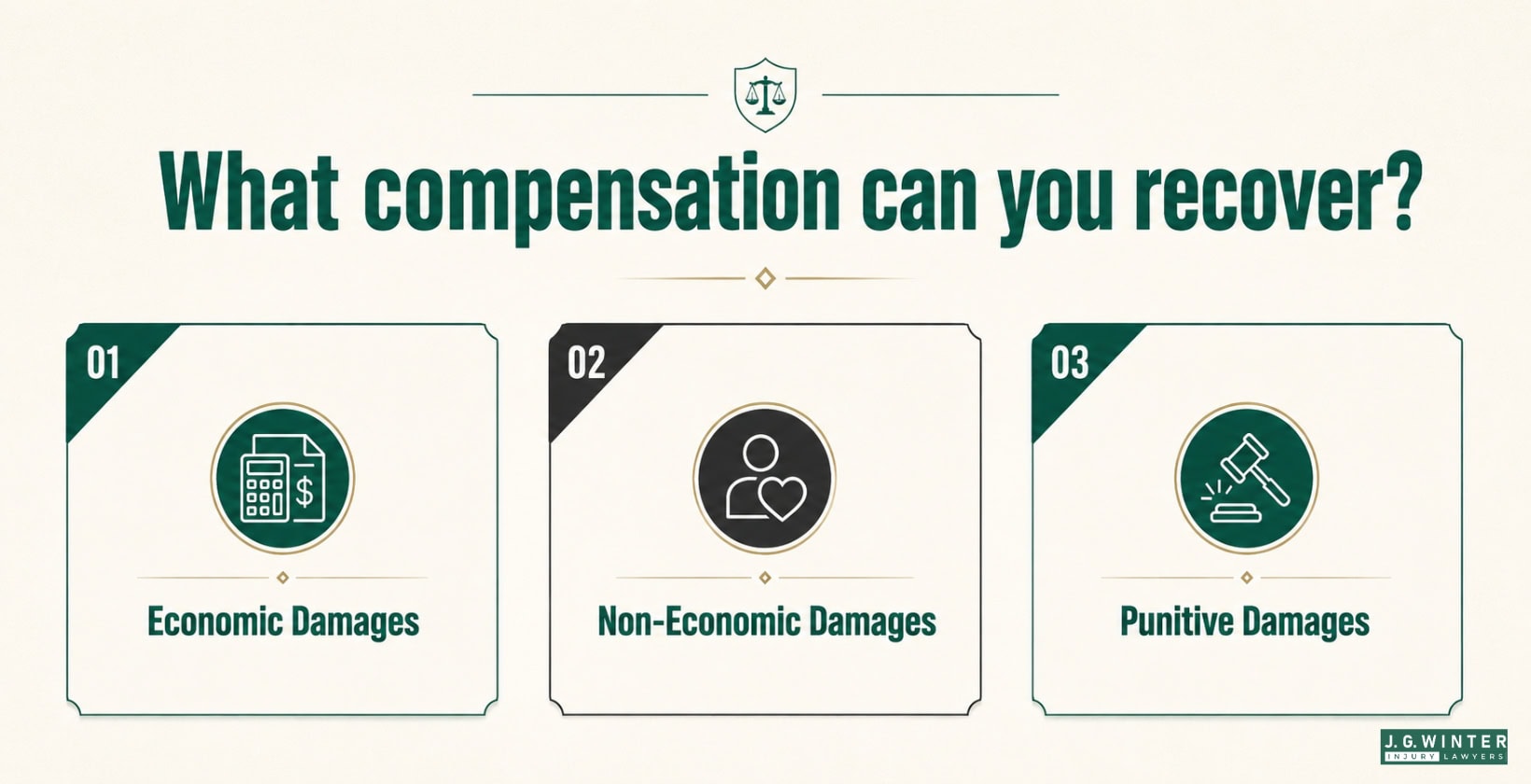
A catastrophic injury case in California can include recovery for three categories of damages. The difference between a fair result and an inadequate one usually comes down to how thoroughly the second and third categories are documented.
- Economic Damages cover losses that carry a calculable dollar value: past and future medical expenses including surgeries, hospitalizations, medications, and therapies; future care costs projected over the claimant’s life expectancy; lost wages from the period of incapacity; lost earning capacity for a person who cannot return to their prior career or any equivalent employment; the cost of home modifications, assistive technology, and personal care assistance; and out-of-pocket expenses directly caused by the injury.
- Non-Economic Damages compensate for the human cost of the injury: pain and suffering, loss of enjoyment of life, emotional distress, and, where a spouse’s life has been affected, loss of consortium. California imposes no statutory cap on non-economic damages in personal injury cases (except medical negligence). These damages are often the largest component of a catastrophic injury recovery, and they require the same documentary foundation as economic losses.
- Punitive Damages require proof by clear and convincing evidence that the defendant acted with malice, oppression, or fraud under California Civil Code §3294. That is a higher standard than the rest of the case. It does not apply in every situation, but it is worth discussing with Jeremy if a defective product was knowingly sold, a construction site had documented safety violations, or a driver was impaired.
Learn more about how to increase your settlement value in a serious California injury case.
The Result Far Exceeded My Expectations
I am beyond grateful for the exceptional service I received from J.G. Winter Law. From start to finish, their team was incredibly professional, supportive, and knowledgeable. They handled my personal injury case with great care and kept me informed every step of the way. Thanks to their hard work and dedication, I was able to achieve a fantastic result that far exceeded my expectations.
What is a life care plan, and do you need one?
A life care plan is a document prepared by a credentialed life care planner, typically a registered nurse or rehabilitation professional with specialized training, that itemizes every medical service, equipment purchase, therapy session, home care hour, and facility cost a catastrophically injured person will require from the date of the plan through the end of their projected life. It is not a wishlist. It is a professionally supported forecast that must withstand cross-examination by the defense’s own experts.
For any catastrophic injury case in California, yes. Without a life care plan, future medical costs are speculative to a jury and negotiable to an insurer. Most catastrophic injury settlements are negotiated without one, which is why they routinely fail to account for care costs that don’t appear until years after the case closes. Insurers settle based on what they believe a jury will award, and juries only award future medical costs to the extent those costs have been documented by credible experts. A case without a plan, or with a weak one, gives the insurer every reason to offer a fraction of what lifetime care will actually cost.
Jeremy works with life care planners who collaborate with physiatrists (rehabilitation medicine physicians), neurologists, and economic experts who calculate the present value of the projected future costs. That present-value calculation matters because a $2,000,000 thirty-year care plan has a specific present value today, and that number is what the insurer’s actuary is working from. A life care plan built before treating physicians have established maximum medical improvement (MMI) understates future needs and hands the defense a tool to discount the claim. Getting Jeremy involved before the plan is commissioned ensures the timing is right and the structure answers the specific challenges the defense will raise.
How long do you have to file a catastrophic injury claim in California?
California’s standard personal injury statute of limitations is two years from the date of injury, under California Code of Civil Procedure §335.1. Miss that deadline and the court will dismiss the claim regardless of its merit. Two years sounds like ample time, but catastrophic injury cases require months of medical stabilization, expert retention, and life care plan preparation before a demand can be sent, so the window closes faster than it appears.
If a government entity caused the injury, the deadline is far shorter, and missing it bars the claim. Under California Government Code §911.2, you have only six months from the date of the incident to file an administrative claim against a city, county, state agency, or other public entity. This is not the standard two-year personal injury window. It is a separate, shorter requirement, and missing it bars the claim against the government entity in nearly all circumstances. If the road that caused the accident was a government-maintained highway, if a public vehicle was involved, or if the injury occurred on public property, the six-month government claim rule may apply.
For minors, the two-year period generally does not begin until the child turns 18. However, when a government entity may be responsible, the six-month administrative claim deadline is not tolled for minors. A parent or guardian must file that claim within six months of the incident on the child’s behalf.
You can access California court self-help resources for general procedural guidance, but the safe approach is to call Jeremy at (916) 702-7870 as soon as the injury occurs.
How Jeremy Winter handles catastrophic injury cases in Folsom
Most personal injury firms assign catastrophic cases to an associate or a rotating team. At the Law Offices of J.G. Winter, Jeremy Winter is the only attorney, and he handles every case personally from the first call through resolution. That is not a marketing claim. It is the structure of the firm.
Jeremy’s approach to a catastrophic injury case follows a specific sequence built around the life care plan. Immediate evidence preservation comes first. The days immediately after a catastrophic accident are when the most important physical evidence exists: vehicle data recorders, construction site conditions, product defect documentation, and witness memory. Jeremy moves quickly to secure that evidence before it is lost, modified, or destroyed.
He then waits until the treating physicians have a clear picture of permanence before retaining the life care planner, the physiatrists and neurologists needed to support the plan, and the economic expert who will calculate present value. Accident reconstruction specialists are retained when causation or the sequence of events is in dispute. As a Folsom personal injury attorney with 20 years of serious injury experience, Jeremy prepares every case as though it is going to trial.
Whether the injury arose from a construction accident in Folsom or a collision on the Highway 50 corridor, clients treated at Mercy Hospital of Folsom (1650 Creekside Dr, Folsom, CA 95630) or UC Davis Medical Center in Sacramento can reach Jeremy 24/7. Schedule a free case consultation.
Verified case results
|
Result |
Case Type |
|
$19,000,000 |
Construction Accident |
|
$5,000,000 |
Product Defect |
|
$3,500,000 |
Commercial Truck Accident |
|
$1,600,000 |
Policy Limits (Food Delivery vs. Pedestrian) |
|
$1,500,000 |
Car Accident |
|
$1,400,000 |
Slip and Fall |
|
$1,000,000 |
Premises Liability |
|
$1,000,000 |
Rear End Accident |
|
$900,000 |
Injury in a Vacation Rental |
Prior results do not guarantee a similar outcome. See our verified case results.
Frequently asked questions
How long do catastrophic injury cases take to resolve?
One to three years is the range for most cases in California, and some go longer. That timeline is not delayed. Jeremy will not build a life care plan or send a demand until treating physicians have established maximum medical improvement and can speak to permanent impairment. A plan built too early understates future needs, and an insurer will use that understatement at the settlement table. Cases that go through depositions and expert discovery take more time, but the results tend to reflect the full value of lifetime care rather than a discounted early offer.
How do I get medical treatment if I can’t afford it while my case is pending?
Treatment does not have to wait for the case to resolve. Jeremy works with medical providers who treat catastrophic injury clients on a letter of protection: a written commitment that the bills will be satisfied from the case recovery. That arrangement covers specialist care, surgery, and rehabilitation that private insurance may not fully fund.
How much does it cost to hire a catastrophic injury lawyer in Folsom?
Nothing upfront. Jeremy works on a 100% contingency fee: no attorney fee is owed unless compensation is recovered. Case costs and expenses (filing fees, expert witness fees, medical records) are separate from attorney fees and may be owed even if the case does not result in a recovery. If you want to understand how attorney fees work before you call, read the cost to hire a personal injury lawyer in California.
Can family members recover damages for a loved one’s catastrophic injury?
In California, family members may have independent claims depending on their relationship to the injured person. A spouse may recover for loss of consortium, meaning the loss of companionship, support, and the marital relationship caused by the injury. In cases where the catastrophic injury later results in death, family members may pursue a wrongful death claim under California Code of Civil Procedure §377.60. The intersection of the personal injury claim and a potential wrongful death case requires careful legal analysis.
What if a government entity caused the injury?
If a city, county, state agency, or other public entity caused the catastrophic injury, California Government Code §911.2 requires you to file an administrative claim against that entity within six months of the incident. This is a separate, shorter requirement from the two-year personal injury statute of limitations. Missing it bars the claim against the government entity in nearly all circumstances. Contact our personal injury attorney at (916) 702-7870 immediately if a government entity may be involved.
Can I still recover if I was partially at fault?
Yes, and insurers count on you not knowing that. California follows the pure comparative negligence rule. The rule reduces your recovery by your percentage of fault, but it never eliminates your right to recover damages. If your total damages are $2,000,000 and a jury finds you 30% at fault, you recover $1,400,000. Insurers raise comparative fault arguments as a standard negotiating tactic, not because the facts always support them. Jeremy reviews the accident evidence to challenge fault allocations that the physical record does not back up.
What if my injury prevents me from ever returning to work?
Lost earning capacity is a recoverable economic damage in California, separate from lost wages. Lost wages cover income you have already missed; lost earning capacity covers the income you will never be able to earn over the rest of your working life because of the permanent effects of the injury. Calculating that figure requires an economic expert who analyzes your prior earnings, your occupation, your age, your remaining work-life expectancy, and the vocational limitations imposed by the injury.
Will my case go to trial?
Most catastrophic injury cases resolve before trial, but the settlements that come out of that process are shaped by whether the insurer believes the case is fully prepared. Jeremy builds every case as though it is going to trial: retaining the right experts, preserving evidence, completing the life care plan, and preparing for the specific defenses the other side will raise. If the insurer’s offer does not reflect the true value of lifetime care, Jeremy will take the case to trial.
My injury happened at a construction site. Can I still file a personal injury claim if I’m receiving workers’ comp?
Yes. Workers’ compensation covers your medical bills and a portion of lost wages, but it does not compensate for pain and suffering, full lost earning capacity, or the lifetime care costs a catastrophic injury produces. California Labor Code §3852 preserves your right to file a separate third-party lawsuit against the general contractor, subcontractor, property owner, or equipment manufacturer whose negligence caused the injury. That third-party claim can recover what workers’ comp never pays.
Contact a Folsom catastrophic injury lawyer
A catastrophic injury puts a lifetime of medical costs into motion on the day it happens. The amount your case resolves for depends in large part on how quickly the right experts are retained, how thoroughly the life care plan is built, and whether the attorney presenting that plan has the credibility and preparation to back it up.
Jeremy Winter has handled serious injury cases in Folsom and throughout Northern California for 20 years. He lost his mother in a car accident when he was 18 years old. That experience is part of why he takes catastrophic injury cases personally and why he is available to speak with injured clients and their families at any hour.
“I Care Because I’ve Been There.”
Call Jeremy at (916) 702-7870 or get a free consultation online.
Get a free, no-obligation case evaluation from an experienced Folsom injury attorney.
94 verified Google Reviews
Proven Results
100M+ recovered
Experienced Attorneys
20 years of personal injury experience
Contingency Basis
No fee unless we win your case
24/7 Support
Call us anytime

The Right PI Attorney Makes All The Difference.
After an accident, who you hire matters. We've spent years fighting for families just like yours and we're ready to fight for you.
Law Offices of J.G. Winter is Near You
You've been through enough. At the Law Offices of J.G. Winter, we're dedicated to fighting for personal injury victims and helping them reclaim their lives. Whether you're close to our offices or further away, please don't hesitate to reach out - location should never stand between you and the justice you deserve. We're continuously growing our service areas because your needs always come first. We're available whenever you need us - just reach out.
Injured in an Accident?
We Can Help.
Get a free, no-obligation case evaluation from an experienced Northern California injury attorney.
Or fill out the form.