
Folsom Brain Injury Lawyer
If you suffered a brain injury in Folsom, J.G. Winter Law helps victims pursue compensation for medical care, lost income, and long-term effects. We build strong claims with medical evidence, work with experts when needed, and fight to protect your rights.




Why Hire Our Folsom Brain Injury Lawyer?

Committed to protecting clients' rights and pursuing favorable outcomes through diligent legal representation.

Since 2006, our firm has represented clients across California with dedicated, personalized legal guidance.

Personalized attention, responsive communication, and dedicated legal support from start to finish.

Speak with an experienced attorney at no cost to discuss your legal rights and options.
68,663 people died from traumatic brain injuries in the United States in 2023, according to the CDC TBI data. Most survivors who walk away from a collision, fall, or workplace accident never appear in that number, and many don’t realize the injury they sustained.
A clean CT scan is not a clean bill of health. Insurance adjusters know that diffuse axonal injury, post-concussion syndrome, and the cognitive deficits that reshape a person’s life rarely appear on standard imaging. They count on claimants not knowing the same thing.
Jeremy Winter, a Folsom traumatic brain injury lawyer working from 102 Natoma St, Ste A, personally handles every TBI case at the Law Offices of J.G. Winter. Jeremy builds TBI cases through neuropsychological testing, treating neurologist and physiatrist records, family and coworker witness statements documenting behavioral change, and employment baselines that give a jury a precise before-and-after picture. If you or someone you love sustained a head injury anywhere along the Highway 50 corridor, on East Bidwell Street, or on the American River Bike Trail, reach out to our personal injury attorney 24/7 at 844-734-2626.
Why Folsom TBI victims work with Jeremy Winter:
- 20 years of personal injury experience
- Verified case results, including a $19,000,000 construction accident settlement and a $3,500,000 commercial truck accident settlement
- 4.9-star rating from 146+ verified client reviews
- 100% contingency fee: no attorney fee unless compensation is recovered
- 24/7 availability at 844-734-2626.
- Bilingual English/Spanish: full-service representation in both languages
Prior results do not guarantee a similar outcome. Every case is unique, and the value of any claim depends on its specific facts.
He Has Fought for Me Every Step of the Way
The course of my life changed on April 22, 2020. I was walking on my road and I was hit by a Suburban. I sustained multiple breaks in my left leg, a fractured skull and a brain injury. He has fought for me every step of the way to be compensated for the injuries I sustained. Every time I had to be seen in the emergency room, every doctor visit or obtaining the correct physical therapy, Jeremy has always been a text or phone call away.
EXCELLENT Based on 101 reviews
 Posted on Google
 Francisco23 days agoJanet and Sergio were a great help to me; I spoke with them and they will be helping me with my injury. I highly recommend lawyer Jeremias.
(Translated by Google, see original)Posted on Google Oscar Vega25 days agoHi, my name is Oscar. I was in an accident where I was rear-ended, causing injuries. I called 911, but the police never arrived. The other person blamed me. Insurance companies don't usually help much, which is why I went to Jeremias's law firm. They are a great team of professionals. Thank God they helped me, especially Diana Becerra, who was always attentive to my medical appointments and therapy sessions. Thanks to her excellent work, the entire team, and attorney Jeremias, they won my case. I highly recommend them. If you've been in an accident, believe me, they will work professionally for you. You deserve more. You deserve the best. You deserve Jeremias.
(Translated by Google, see original)Posted on Google Flako sanchez28 days agoPosted on Google
 Santi36 days agoVery helpful and kind. Lot of good info. I know who callPosted on Google
 sam_i_am36 days agovery helpful team and good info on event highly recommendPosted on Google
 Mari Hernandez36 days agoA great team, everyone is very friendly. Always willing to answer any question, very helpful.
(Translated by Google, see original)Posted on Google Junior Rodriguez36 days agoGreat law firm, very helpfulPosted on Google
 Lordk4rn4ge36 days agoI meet them and they were really friendly.Posted on Google
 Rebeca Luna36 days agoPosted on Google
 Iveth Bucio36 days agoSergio, Adriana, and Jeanette provided excellent service, giving valuable information at the resource desk.
(Translated by Google, see original)Verified by TrustindexTrustindex verified badge is the Universal Symbol of Trust. Only the greatest companies can get the verified badge who has a review score above 4.5, based on customer reviews over the past 12 months. Read more
What is a traumatic brain injury?
A traumatic brain injury (TBI) is any injury that disrupts normal brain function as a result of a blow, jolt, or penetrating trauma to the head. TBIs range from mild concussions with brief disorientation to severe injuries involving extended loss of consciousness and permanent cognitive damage.
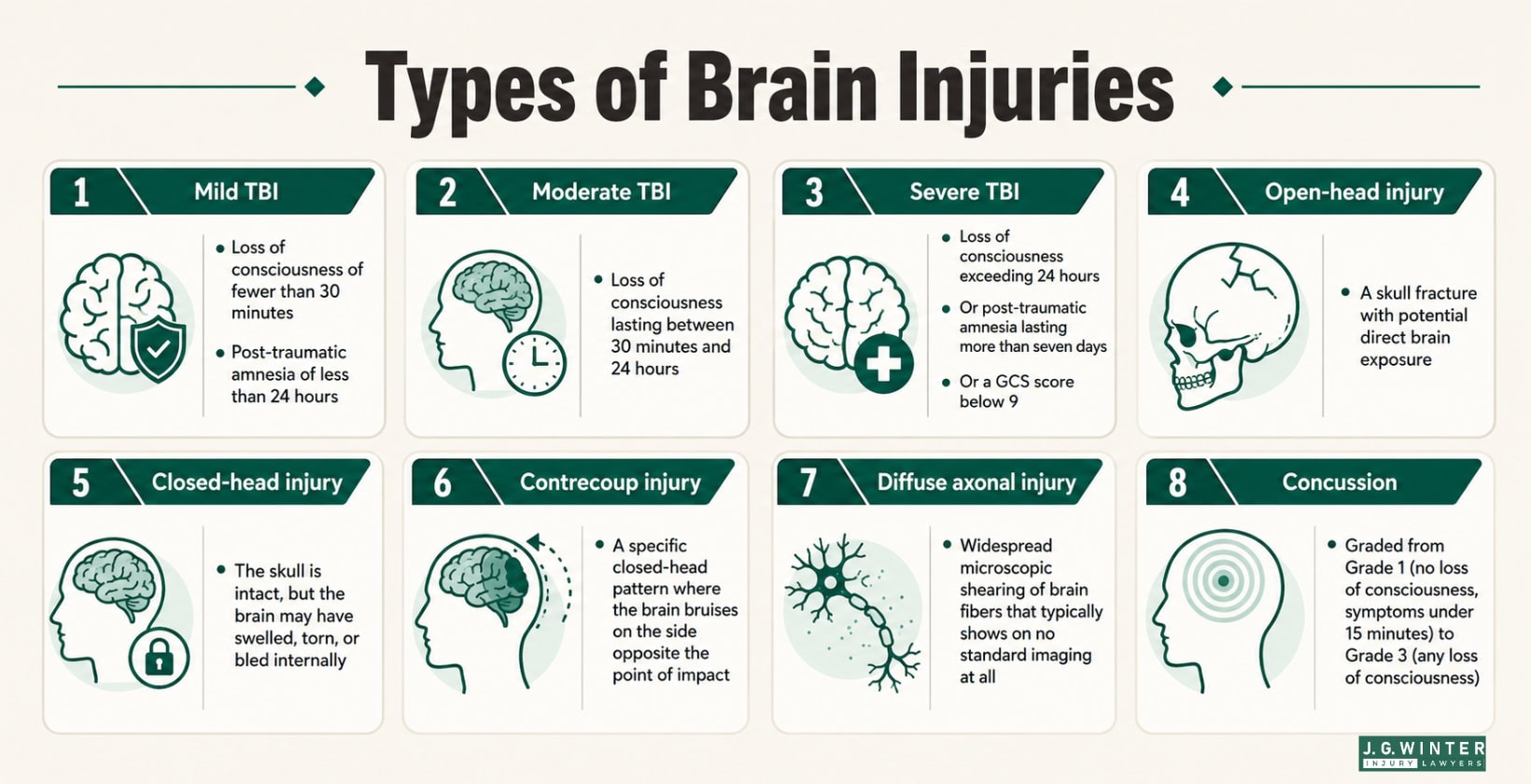
Clinicians classify TBI severity using the Glasgow Coma Scale (GCS), a standardized scoring tool that measures eye, verbal, and motor responses after the injury. A mild TBI involves a loss of consciousness of fewer than 30 minutes and post-traumatic amnesia of less than 24 hours. A moderate TBI involves a loss of consciousness lasting between 30 minutes and 24 hours. A severe TBI involves loss of consciousness exceeding 24 hours, or post-traumatic amnesia lasting more than seven days, or a GCS score below 9.
The distinction between open-head and closed-head injuries matters both medically and legally. An open-head injury involves a skull fracture with potential direct brain exposure; a closed-head injury means the skull is intact, but the brain may have swelled, torn, or bled internally. A contrecoup injury is a specific closed-head pattern where the brain bruises on the side opposite the point of impact. Diffuse axonal injury refers to widespread microscopic shearing of brain fibers that typically shows on no standard imaging at all.
A concussion is graded from Grade 1 (no loss of consciousness, symptoms under 15 minutes) to Grade 3 (any loss of consciousness). Even Grade 1 concussions dismissed as “minor” by insurers can produce lasting neurological symptoms when left untreated or when a second impact follows before the brain recovers.
Warning signs of a traumatic brain injury
Many TBI symptoms do not appear immediately. Some develop over 24 to 72 hours after the initial trauma, which is why an absence of symptoms at the accident scene should never be taken as confirmation that no injury occurred.
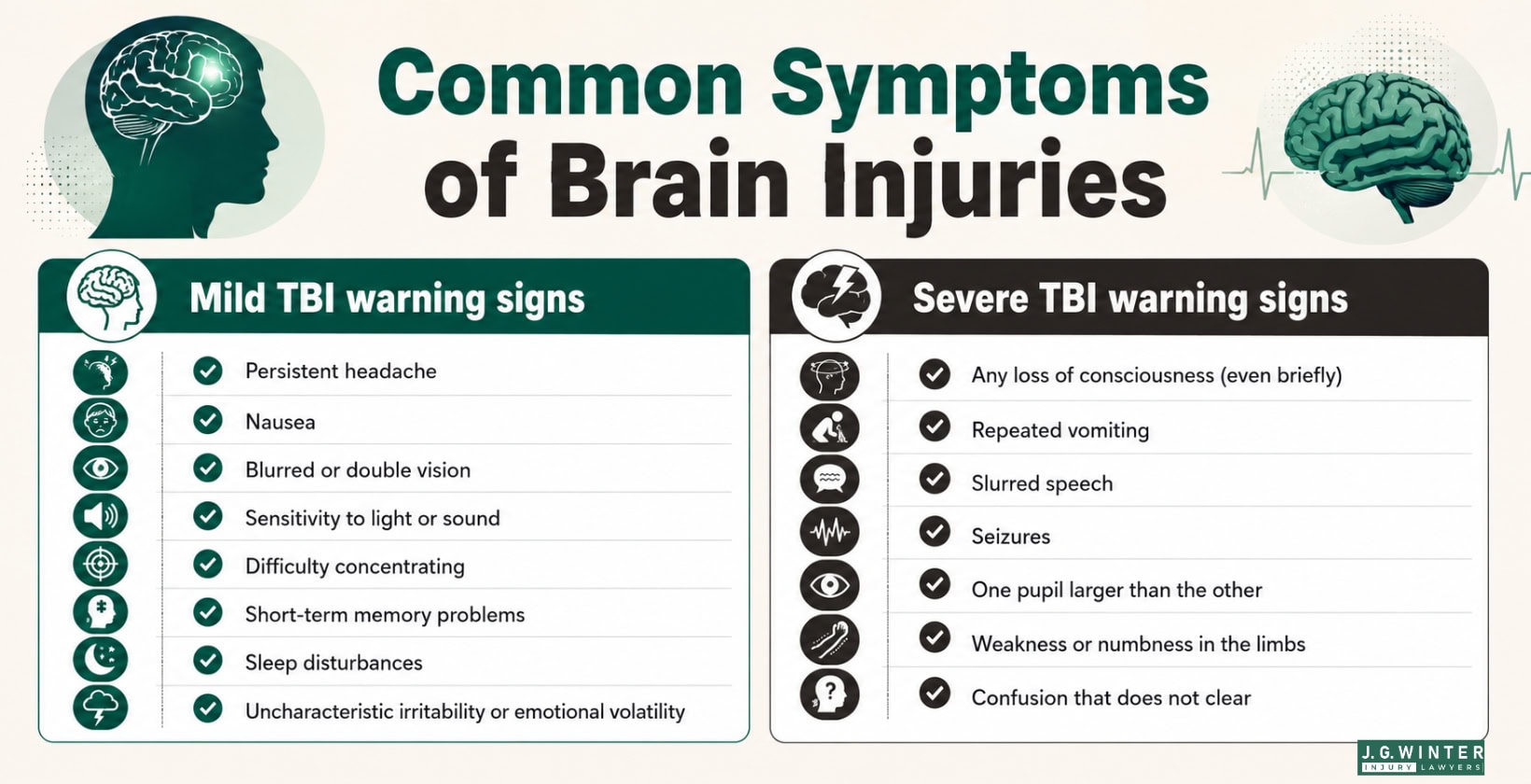
Mild TBI warning signs include persistent headache, nausea, blurred or double vision, sensitivity to light or sound, difficulty concentrating, short-term memory problems, sleep disturbances, and uncharacteristic irritability or emotional volatility. These symptoms are often mistaken for stress or fatigue, allowing the injury to go undiagnosed while the legal clock runs.
Severe TBI warning signs include any loss of consciousness (even briefly), repeated vomiting, slurred speech, seizures, one pupil larger than the other, weakness or numbness in the limbs, and confusion that does not clear. If any of these signs appear after a blow to the head, call 911 immediately. Mercy Hospital of Folsom is located at 1650 Creekside Dr, Folsom, CA 95630, and UC Davis Medical Center in Sacramento functions as a Level I Trauma Center for the most critical cases.
Post-Concussion Syndrome (PCS). When concussion symptoms persist beyond three months, treating physicians frequently document this as post-concussion syndrome under established ICD-10 criteria (code F07.81). It is a recognized condition in California personal injury litigation that is compensable independent of initial concussion severity.
Headaches, cognitive fog, sleep disruption, irritability, and light sensitivity that continue long after the accident are documented injuries, not normal recovery. Insurance adjusters routinely characterize PCS as anxiety or a pre-existing mental health condition. Jeremy builds PCS cases through neurologist documentation, neuropsychological testing, and occupational impact records showing how the syndrome limits the client’s ability to work and function.
Common causes of TBI in Folsom
Folsom’s geography creates specific TBI risks. Highway 50 carries commuter and commercial traffic at sustained highway speeds through the city, and rear-end and intersection collisions on that corridor regularly produce the kind of sudden rotational forces that cause diffuse axonal injury even without visible head impact.
- Motor vehicle accidents are the single most common cause of TBI claims Jeremy handles, whether the collision occurs on Highway 50, at the East Bidwell Street interchanges, or on local surface streets. A Folsom car accident lawyer can handle the liability side of the case while Jeremy coordinates the medical documentation needed to prove the neurological harm.
- Bicycle and pedestrian accidents on the American River Bike Trail, where a fall from a moving bicycle without a helmet or a collision with an inattentive driver can produce severe closed-head injuries, generate a significant share of the TBI cases Jeremy handles in Folsom.
- Slip and fall accidents in commercial properties, construction sites, and parking structures throughout Sacramento County produce TBIs when the head strikes a hard surface directly. Slip and fall injury cases involve premises liability alongside the brain injury claim itself.
- Construction site accidents, including falling object impacts, scaffold falls, and equipment rollovers, regularly produce catastrophic TBIs. Our construction accident lawyer has obtained $19,000,000 in a construction accident case, reflecting the severity these incidents can reach.
- Truck accidents, where the disparity in mass between a commercial vehicle and a passenger car amplifies the rotational forces on the brain, have produced a $3,500,000 commercial truck accident result in the firm’s truck accident case history.
If the mechanism of your injury does not appear in this list, that does not mean you do not have a viable claim. Call (916) 702-7870 to discuss what happened.
What evidence proves a traumatic brain injury case?
Proving a TBI claim means going further than what a radiology report shows. Jeremy knows how to prove a brain injury that does not appear on standard imaging, and that proof typically requires multiple categories of evidence working together.
- Neuropsychological testing produces the most objective documentation in a well-built TBI case. These standardized assessments measure memory, attention, processing speed, executive function, and emotional regulation. They generate documented deficits that a defense expert has to address directly. When standard imaging is also normal, MRI with diffusion tensor imaging (DTI) can detect microscopic white matter damage that CT and conventional MRI miss, and DTI findings have become a standard advanced imaging tool in serious TBI litigation.
- Treating specialist records from a neurologist, physiatrist, or physical medicine and rehabilitation specialist carry the greatest evidentiary weight with insurers and juries. These professionals document the clinical course of the injury over time, including changes from one visit to the next, and their testimony connects the mechanism of the accident to the neurological findings.
- Witness statements from family members and coworkers document behavioral changes that the injured person may not fully recognize in themselves. A spouse who describes that their partner can no longer follow a conversation, or a supervisor who notes that a formerly reliable employee now misses deadlines and loses track of tasks, provides functional evidence of long-term effects that supplements clinical findings.
- Accident reconstruction and scene evidence establish the mechanism of injury. The force of impact, the angle of collision, and the physical circumstances of a fall all help explain why the brain sustained the particular pattern of damage the medical records document.
- Prior employment and education records serve as a baseline. Comparing pre-injury performance to post-injury function, using school transcripts, work evaluations, and earnings history, gives the jury a concrete before-and-after picture.
Like Having a Guardian Angel on My Shoulder
I want to thank Attorney Jeremy and his team at J.G. Winter Injury Lawyers for how much they have done for me. I can’t imagine going through this process alone. Having them in my corner was like having a guardian angel on my shoulder — I felt like I was part of their family. They are so kind and caring, yet aggressive and ready to fight for you when it comes to dealing with the insurance companies and greedy corporations. They really know their stuff, and won’t back down from anyone.
Why you must see a doctor immediately after a head injury
Seeing a doctor immediately after any head impact does two things at once: it protects your health, and it creates the documentation that your brain injury claim in California will depend on. A gap in medical care between the accident and your first treatment visit is one of the most common arguments insurance companies use to argue that your symptoms are unrelated to the crash.
From a medical standpoint, some TBIs worsen rapidly. A brain bleed that appears minor at first can expand within hours and become life-threatening. Early imaging, neurological evaluation, and specialist referral are not precautionary overreactions; they are the standard of care, and following that standard protects your recovery.
From a legal standpoint, every visit to a treating physician, every referral to a neurologist, and every session of neuropsychological testing generates a record. Those records become the foundation of your case. An insurance adjuster cannot dismiss documented cognitive deficits the way they can dismiss a verbal complaint; the paper trail forces them to address the evidence directly.
What damages can you recover for a TBI in California?
California does not cap non-economic damages in personal injury cases, which means the full scope of what a TBI takes from a person’s life is recoverable. Medical malpractice claims are subject to separate statutory limits under MICRA, which apply if the TBI resulted from a healthcare provider’s negligence rather than a vehicle accident, fall, or other third-party act.
Understanding how much a brain injury claim is worth depends on the specific facts of your case, but the categories of recovery are well established.
- Economic damages cover past and future medical costs: emergency treatment, hospitalization, imaging, neurologist visits, neuropsychological evaluation, cognitive rehabilitation, and ongoing specialist care. They also include lost wages during recovery, reduced earning capacity if the injury limits your ability to work at your prior level, in-home care if daily assistance is required, and rehabilitation equipment or home and vehicle modifications.
- Non-economic damages include physical pain and suffering, both past and ongoing; emotional distress, anxiety, depression, and the documented psychological impact of the injury; loss of enjoyment of life, including inability to participate in activities that defined the person before the injury; and loss of consortium for a spouse whose relationship has been affected by the injury’s cognitive and behavioral consequences.
- Future damages are compensable in California when they are reasonably certain to occur. For a severe TBI, this includes decades of ongoing care, lost career earnings, and sustained pain and suffering. Jeremy works with life care planners, vocational rehabilitation experts, and economists to document what these future costs actually amount to.
California follows a system of pure comparative fault. Even if you were partially at fault for the accident, you can still recover. If a jury finds you 20% responsible for the collision that caused your TBI, you recover 80% of your total damages. Being partly at fault does not end your claim.
The Result Far Exceeded My Expectations
I am beyond grateful for the exceptional service I received from J.G. Winter Law. From start to finish, their team was incredibly professional, supportive, and knowledgeable. They handled my personal injury case with great care and kept me informed every step of the way. Thanks to their hard work and dedication, I was able to achieve a fantastic result that far exceeded my expectations.
How long do you have to file a TBI lawsuit in California?
California’s personal injury statute of limitations sets a two-year deadline for personal injury claims, including TBI cases. You have two years from the date of your injury to file a lawsuit under California Code of Civil Procedure §335.1. If you miss that deadline, the court will dismiss your claim regardless of how strong the evidence is.
There is a critical exception for TBI cases involving government entities. If the at-fault party is a city, county, state agency, or government employee acting in their official capacity, Government Code §911.2 requires you to file a government tort claim within six months of the incident. This six-month window is not extended by the two-year personal injury deadline, and missing it typically bars your claim entirely against that government entity.
The two-year clock can also be affected by discovery delays. If a TBI’s symptoms were not apparent immediately and a reasonable person would not have recognized the connection between the accident and the neurological harm until a later date, California’s discovery rule may toll the limitations period.
One additional exception applies when the injured person is a minor: under California Code of Civil Procedure §352(a), the two-year clock generally does not begin until the minor turns 18. If a child sustained a head injury in a Folsom bicycle crash, pedestrian accident, or sports accident, that tolling rule may preserve a claim that appears time-barred.
Do not assume you have more time than the date of the accident suggests. Reach Jeremy at (916) 702-7870.
How insurance companies deny TBI claims — and how Jeremy fights back
In Jeremy’s experience handling brain injury cases across Northern California, TBI claims draw more aggressive insurer pushback than almost any other injury category he handles, and the reason is specific: TBI damages are enormous, and TBI evidence is often invisible. A broken bone resolves, and the case closes. A TBI can require care for decades, and the non-economic damages alone can reach seven figures.
The most common insurance tactic is the “clean scan” argument. An adjuster or defense expert reviews an early CT scan, notes no visible hemorrhage or structural abnormality, and concludes that no significant brain injury occurred. This argument ignores the reality that diffuse axonal injury and many forms of mild-to-moderate TBI do not show on standard CT imaging at all. Jeremy knows how to negotiate with insurers that use this tactic, and he responds with neuropsychological testing results and treating neurologist testimony that speak directly to function, not just anatomy.
A second common tactic is arguing that the symptoms are pre-existing or attributable to a separate cause, such as stress, aging, or a prior medical condition. Jeremy addresses this by building a detailed pre-injury baseline from employment records, school records, and prior medical history, then comparing it to the documented post-injury function.
A third tactic is surveillance and social media monitoring. Adjusters look for evidence that the claimant is engaging in activities that seem inconsistent with reported limitations. Jeremy prepares clients for this from day one and ensures the medical documentation reflects the real pattern of good days and bad days that TBI survivors actually experience.
The Brain Injury Association of America reports that more than 5 million Americans are living with a TBI-related disability, a figure that directly counters insurer arguments that TBI is a short-term condition. Every case Jeremy takes is prepared as a catastrophic injury case with the potential to go to trial, because that preparation is what produces fair settlements.
Why Folsom TBI victims choose Jeremy Winter
Jeremy Winter handles every case personally. There are no associates assigned to your file, and no handoffs to paralegals after the intake call. When you call (916) 702-7870, you reach the attorney who will be in the room for every deposition, every mediation, and every trial. That is what “I Care Because I’ve Been There” reflects in practice.
Jeremy lost his mother in a car accident when he was 18 years old. That experience is part of why he chose personal injury law, and it shapes how he treats the people who call his office. He is not processing cases on a volume model. He represents people during one of the most disorienting and frightening periods of their lives, and he treats that responsibility accordingly.
The Law Offices of J.G. Winter operates on a contingency fee basis: no attorney fee unless a recovery is made on your behalf. You should know that, depending on the circumstances of your case, you may owe litigation costs and expenses even if no recovery is obtained. Jeremy will explain the fee arrangement clearly before you sign anything. As a Folsom personal injury attorney deeply familiar with the local courts, medical providers, and the Sacramento County Superior Court, Jeremy is positioned to move your TBI case forward from the first consultation.
The office at 102 Natoma St, Ste A, Folsom, CA 95630 is available for in-person meetings. For clients who prefer to consult before traveling, phone and video appointments are available 24 hours a day at 844-734-2626.
TBI case results
The following results were obtained by the Law Offices of J.G. Winter for actual clients. Every figure listed here reflects a real outcome from a real case.
|
Result |
Case Type |
|
$19,000,000 |
Construction Accident |
|
$5,000,000 |
Product Defect |
|
$3,500,000 |
Commercial Truck Accident |
|
$1,600,000 |
Policy Limits (Food Delivery vs. Pedestrian) |
|
$1,500,000 |
Car Accident |
|
$1,400,000 |
Slip and Fall |
|
$1,000,000 |
Premises Liability |
|
$1,000,000 |
Rear End Accident |
|
$900,000 |
Injury in a Vacation Rental |
View the full record at our verified case results.
Prior results do not guarantee a similar outcome. Every case is unique, and the value of any claim depends on its specific facts.
Frequently asked questions
Can I file a TBI claim if symptoms appeared days after the accident?
Yes. Delayed symptom onset is a recognized pattern in TBI cases and does not disqualify your claim. Under California law, the discovery rule can toll the statute of limitations when the injury was not immediately apparent and a reasonable person would not have connected it to the accident right away. The critical step is documenting the timeline precisely: when you first noticed symptoms, when you sought medical evaluation, and what that evaluation found. Jeremy builds this timeline carefully because insurers routinely use delayed diagnosis to argue that the injury came from a different cause.
How long does a TBI case typically take to resolve in California?
It depends heavily on injury severity, disputed liability, and whether the insurer makes a reasonable offer before litigation. Mild TBI cases with clear liability and full insurance coverage can resolve in six to eighteen months. Severe TBI cases, particularly those involving disputed causation, multiple defendants, or significant future damages requiring life-care planner testimony, can take two to four years, and some require trial. The two-year statute of limitations under CCP §335.1 sets the outer deadline for filing, but most cases are actively worked on well before that point. Jeremy gives clients a realistic timeline assessment at the first consultation based on the specific facts of the case, not a generic estimate.
What is the average settlement for a traumatic brain injury in California?
There is no reliable average because TBI settlements vary enormously depending on severity, the extent of documented cognitive and functional impairment, the injured person’s age and earning history, the strength of the liability evidence, and the insurance coverage available. California has no cap on non-economic damages in personal injury cases, which means the full lifetime impact of a severe TBI is recoverable. The right question is not what the average is, but what the specific facts of your case support. Call (916) 702-7870 for an honest assessment.
Does Jeremy Winter handle TBI cases caused by car accidents, truck accidents, and falls?
Yes. Jeremy handles TBI claims arising from motor vehicle collisions, bicycle and pedestrian accidents, slip and fall incidents, construction accidents, and premises liability cases. Car and truck accidents on Highway 50 and throughout Sacramento County are the most common source of TBI claims the firm handles, but the legal and medical framework is consistent across these cause categories. If the accident happened in Folsom or the surrounding Sacramento County area, call to discuss whether Jeremy can take the case.
Do I need a neurologist or specialist for my TBI case?
Yes, both medically and legally. From a medical standpoint, a primary care physician can identify acute symptoms, but a neurologist or physiatrist has the training to evaluate the neurological course of the injury, order appropriate imaging, and refer for neuropsychological testing. From a legal standpoint, the opinions of treating specialists carry far greater weight with insurers and juries than general practitioner notes. Jeremy works with these specialists as both treating providers and, when necessary, expert witnesses who can explain the relationship between the accident, the injury, and the documented functional deficits.
Will my TBI case go to trial or settle?
The large majority of TBI cases resolve before trial through negotiated settlement or mediation. That said, Jeremy prepares every case as if it will go before a jury, because that preparation is what produces settlements that reflect the full value of the claim rather than a discounted number an insurer offers, hoping the claimant will accept to avoid the uncertainty of trial. Severe TBI cases with significant damage and disputed liability are more likely to require trial than mild TBI cases with clear fault and full insurance coverage. Jeremy will give you an honest assessment of where your case sits on that spectrum.
Schedule your free case review
A traumatic brain injury changes things fast. Cognitive deficits, inability to work, mounting medical bills, and an insurance company that keeps saying the scans look fine: this is a specific and devastating combination, and it requires a specific legal response.
Jeremy Winter represents Folsom TBI victims from his office at 102 Natoma St, Ste A, Folsom, CA 95630. The consultation is free, there is no fee unless a recovery is obtained, and the office is reachable 24 hours a day.
“I Care Because I’ve Been There.”
Call 844-734-2626, or schedule a free consultation online.
Jeremy also handles wrongful death claims and can explain what options your family has if you have lost a loved one to a TBI caused by another person’s negligence.
Get a free, no-obligation case evaluation from an experienced Folsom injury attorney.
94 verified Google Reviews
Proven Results
100M+ recovered
Experienced Attorneys
20 years of personal injury experience
Contingency Basis
No fee unless we win your case
24/7 Support
Call us anytime
The Right PI Attorney Makes All The Difference.
After an accident, who you hire matters. We've spent years fighting for families just like yours and we're ready to fight for you.
Law Offices of J.G. Winter is Near You
You've been through enough. At the Law Offices of J.G. Winter, we're dedicated to fighting for personal injury victims and helping them reclaim their lives. Whether you're close to our offices or further away, please don't hesitate to reach out - location should never stand between you and the justice you deserve. We're continuously growing our service areas because your needs always come first. We're available whenever you need us - just reach out.
Injured in an Accident?
We Can Help.
Get a free, no-obligation case evaluation from an experienced Northern California injury attorney.
Or fill out the form.