Injured in a Sacramento truck accident or anywhere in California? You have the right to file a compensation claim, but filing against federal trucking rules, multiple liable parties, and aggressive insurers is far tougher than a car crash claim. This guide reveals your exact steps, who’s responsible, and what your case is worth under California law.
Whether you are ready to file or still unsure where to start, our Sacramento truck accident lawyers offer free case reviews, identify liability, and handle your claim or lawsuit from start to finish. Call J.G. Winter Injury Lawyers at (844) 517-0586.
Key Takeaways
- Filing a truck accident claim starts with gathering solid evidence: accident reports, medical records, witness statements, and photos of the scene.
- Truck accident cases are more legally complex than car accidents because multiple parties can be responsible, including the driver, the trucking company, cargo loaders, and vehicle manufacturers.
- Hiring a truck accident attorney early protects your rights and gives you the best chance at fair compensation. Insurance companies move fast, and so should you.
- Your claim can cover medical expenses, lost wages, property damage, pain and suffering, and loss of consortium.
- In California, you generally have two years from the date of the accident to file a personal injury lawsuit. Missing this deadline means losing your right to compensation permanently.
Understanding the basics of truck accident claims
Truck accident claims are a necessary element for victims seeking compensation for injuries and damages. These claims help cover medical expenses, lost wages, and other losses. Before jumping into the filing process, it’s crucial to understand why these claims matter. Securing expert legal representation from a personal injury attorney early on makes the entire legal process easier and protects your rights throughout the progression of your legal case.
Gathering essential evidence for a truck accident claim
Building a strong claim requires thorough evidence collection. This evidence forms the backbone of your case, helping to establish liability and accurately quantify damages. Collecting everything from accident reports and medical records to witness statements and photographs of the accident scene is crucial.
The impact of truck accidents on victims and families
The consequences of truck accidents extend far beyond physical injuries. Victims and their families often face emotional and financial burdens that can persist long after the accident. Here, we will highlight the importance of legal guidance in securing financial relief for medical bills, ongoing care costs and compensation for emotional distress.
Importance of understanding truck accident claims
Grasping the nuances of truck accident claims is the first step toward obtaining fair compensation. Understanding your legal rights and having a qualified legal source break down the intricacies of the claims process can significantly impact the outcome of your case.
Practical guidance for truck accident claimants
Filing a truck accident claim involves several key steps. From initial legal consultations to dealing with the complexities of legal procedures, each phase plays an important role in the success of your claim.
Key considerations when filing
When preparing to file your claim, focus on:
- Documentation: Gather and preserve evidence such as accident reports, medical records, witness statements, and accident scene photographs and diagrams.
- Legal representation: Secure support from experienced attorneys specializing in commercial vehicle accidents, truck accident injuries, or semi-truck accidents.
- Expertise: Ensure your legal team possesses the necessary expertise in truck accident litigation and proven results from past cases to effectively negotiate with insurance companies and represent your interests in court.
Timeline for the claim process
Understanding the timeline of your truck accident claim helps set realistic expectations:
- Initial consultation: Discuss your case specifics with a qualified attorney.
- Investigation: Collect necessary documentation and evidence.
- Filing the claim: Officially submit your claim.
- Negotiation: Work towards a fair settlement.
- Litigation: Proceed to court if necessary.
- Resolution: Finalize the settlement or court judgment.
Determining the value of your claim
Evaluating your claim involves calculating potential compensation, considering the following:
- Medical expenses: Immediate and long-term.
- Lost wages: Due to work absence.
- Property damage: Costs to repair or replace.
- Pain and suffering: Emotional and physical distress.
- Legal fees: Attorney fees and other legal costs.
Assess the potential worth of your claim with our no-cost evaluation service.
Legal aspects of truck accident claims
Truck accident claims involve legal aspects that are often more intricate than car accidents, thus necessitating specialized truck accident legal advice. Additionally, a more expert skill level of legal procedure is required to handle trucking accident litigation and provide court-related legal representation for any 18-wheeler accident claim. Understanding the guide to truck accident claims ensures clarity on each procedural step in the legal process.
Establishing a formal agreement with your attorney

Signing a formal agreement with your truck accident attorney is crucial for several reasons:
- Clear scope: Defines what the attorney will and won’t do for your case.
- Fee transparency: Sets expectations for legal costs, including contingency fees.
- Mutual protection: Ensures you and your attorney understand your rights and responsibilities.
Effective communication through your law firm
Allowing your law firm to handle all communications ensures the presentation of your case consistently and professionally, which is important for protecting your legal interests.
Discovery phase: Investigating and collecting evidence
The discovery phase in a truck accident case involves gathering and analyzing evidence crucial to building your legal strategy. This phase is significant as it thoroughly investigates all aspects of the accident, including documents and witness testimonies, ensuring your claim is as strong as possible.
Drafting and delivering the injury demand letter
Drafting and sending an injury demand letter is critical in negotiating a truck accident claim with insurance companies. It should detail the extent of your injuries and the compensation required. Here are the essential steps involved:
- Introduction: Clearly state your intention to seek compensation for injuries from the truck accident.
- Detailed account: Describe the accident, injuries, and life impact.
- Documentation: Attach relevant documents, such as medical records, bills, and evidence of lost wages.
- Settlement demand: Clearly state the compensation sought and justify it with damages.
Negotiating a settlement
Negotiating a settlement in a truck accident case requires strategic planning and effective communication.
Here are key strategies to consider:
- Assessment: Evaluate case strength and damages to determine reasonable settlement.
- Initial offer: Make demand reflecting damages and losses.
- Counteroffers: Negotiate and respond to opposing party’s offers.
- Legal counsel: Seek attorney guidance to handle negotiations.
- Documentation: Support demands with evidence (medical bills, records, expert opinions)
Proceeding to trial when necessary
A truck accident case might proceed to trial when you don’t reach a fair settlement. Reasons for proceeding to trial include:
- Disagreement on liability: Parties cannot agree on who is at fault.
- Dispute over damages: Disagreement on the extent of injuries or compensation owed.
- Principle or precedent: One party unwilling to settle due to principles or legal precedent.
- Insurance issues: Insurance companies refuse to offer fair settlement.
Need expert legal representation for your truck accident claim? Contact us today for comprehensive support at every step.
Challenges and expectations
Understanding the challenges and setting realistic expectations in truck accident claims involves dealing with legal complexities and managing the claim process.
Dealing with low settlement offers
When facing low settlement offers from insurance companies in a truck accident case, consider these strategies to protect your interests:
- Don’t accept low offers: Analyze the offer vs. your damages (medical bills, lost wages).
- Counteroffer with evidence: Respond with a justified counteroffer backed by proof (e.g., medical records).
- Negotiate or consult a lawyer: Engage in respectful negotiation or seek legal guidance for a fair settlement.
Settlement vs. trial: Pros & cons
Deciding whether to settle or go to trial involves understanding the benefits and drawbacks of each option, which can significantly affect the outcome of your case.
Here’s a comparison to help guide your decision:
Settlement pros
- Speed: Typically resolves cases faster than trials.
- Lower costs: Generally incurs less in legal fees and expenses.
- Less stress: Avoids the emotional and physical toll of a trial.
- Confidentiality: Keeps details private and out of public record.
Settlement cons
- Lower compensation: This may result in a lower compensation than what a trial could have awarded.
- Limited appeals: Provides little recourse if dissatisfied with the settlement terms.
- No precedent: Does not contribute to legal precedents that might benefit similar cases.
Settlement cons
- Time-Consuming: Can extend over months or years.
- Unpredictable: Results are uncertain and depend on the jury’s perception.
- Higher costs: More extensive preparation leads to greater expenses.
Wondering whether to settle or pursue a trial? Make an informed decision on settling or going to trial with personalized advice from our Rancho Cordova truck accident lawyers.
Types of compensation in truck accident claims
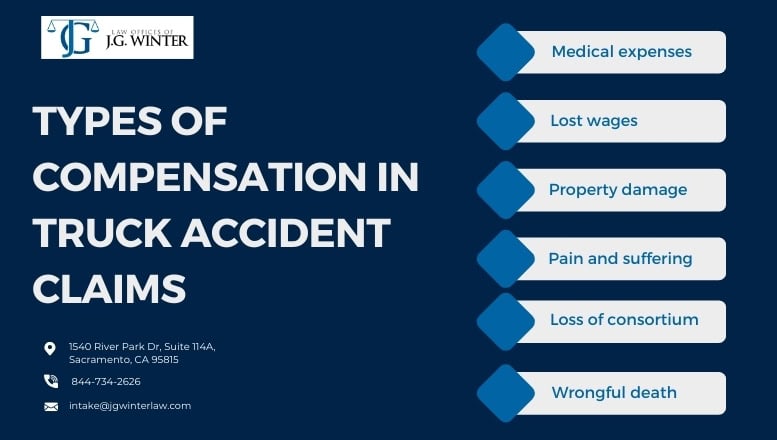
In truck accident claims, various types of compensation can address different aspects of the damages suffered. Understanding the types of compensation available is essential for anyone filing a truck accident claim.
Here are the key categories:
- Medical expenses: Coverage for immediate and long-term medical treatments related to the accident.
- Lost wages: Compensation for income lost due to inability to work during recovery.
- Property damage: Reimbursement for repairs or replacement of damaged property.
- Pain and suffering: Compensation for physical pain and emotional distress caused by the accident
- Loss of consortium: Compensation for the impact of the injury on personal relationships.
- Wrongful death: Financial support for survivors in case of fatal truck accidents.
Discover the full range of compensations you could claim with a tailored case review from our lawyers.
Detailed look at the legal process
Understanding the legal process involved in truck accident litigation requires a clear overview of the necessary steps, supported by competent legal support.
Building a strong case
To build a strong truck accident case, gather compelling evidence and construct a solid legal strategy. Key tips include:
- Gather evidence: Photos, police reports, medical records, witness statements.
- Document details: Weather, road markings, traffic signals.
- Witness testimony: Get statements from people who saw the accident.
- Expert analysis: Consider hiring specialists for accident reconstruction or mechanics.
- Lawyer up: Consult with an experienced Davis truck accident attorney.
Role of expert witnesses
Expert witnesses play a crucial role in truck accident claims by providing specialized knowledge that helps clarify complex issues for the jury or judge.
Here’s what they contribute:
- Medical experts: Explain your injuries and future medical needs.
- Accident reconstruction experts: Analyze crash to explain cause and impact.
- Economic experts: Calculate lost wages and other financial losses.
Factors influencing case outcomes
Several factors can influence the outcome of your truck accident claim. Understanding these can help you and your legal team prepare more effectively:
- Strength of evidence: A strong case relies on clear and thorough evidence, from detailed and immediate accident reports to reliable witness testimony.
- Quality of legal representation: A skilled lawyer can guide you through the legal process and improve your chances of success.
- Defendant’s strategy: Opposing tactics impact your claim. Aggressive defense requires a stronger case.
- Jurisdictional variations: Local laws and the history of cases affect your claim.
Understanding the statute of limitations
The statute of limitations sets critical deadlines for filing a truck accident claim. Adhering to these deadlines is essential:
- Protects your rights: Ensures you can legally pursue compensation before time limits expire.
- Prevents forfeiture: Missing these deadlines can permanently bar you from seeking recovery for your injuries and damages.
Conclusion
Securing fair compensation through a truck accident claim is a complex process that requires understanding, preparation, insight and the right legal support. With the guidance of experienced attorneys, you can go through this journey more effectively and protect your rights.
Begin your journey to justice with a free consultation—start your truck accident claim now!
Filing a truck accident claim: FAQs
Who can be held liable in a California truck accident claim?
Liability in a California truck accident can extend well beyond the driver. The trucking company may be liable if it violated FMCSA regulations, pressured drivers to exceed hours-of-service limits, or failed to properly maintain its fleet. Cargo loading companies can be held responsible if improper loading caused the crash. Vehicle manufacturers may share liability if a mechanical defect contributed. Identifying all liable parties is one of the most important steps an attorney takes early in your case.
How long do I have to file a truck accident claim in California?
California’s statute of limitations gives most truck accident victims two years from the date of the accident to file a personal injury lawsuit (California Code of Civil Procedure Section 335.1). If a government entity is involved, such as a city-owned vehicle or a publicly contracted carrier, the deadline can be as short as six months. Beyond the legal deadline, waiting also risks losing critical evidence. Truck black box data, driver logs, and surveillance footage are often destroyed or overwritten within days or weeks of an accident.
What is the average truck accident settlement in California?
Truck accident settlement amounts vary by case and depend on injury severity, liable parties, and available insurance coverage. Trucking companies are required by federal law to carry significantly higher liability insurance than standard drivers under 49 CFR Part 387, which means policy limits are often far greater than in typical car accident claims.
Do I need a lawyer to file a truck accident claim in Sacramento?
You are not legally required, but truck accident claims are far more complex than standard car accident claims. Trucking companies send insurance adjusters to the scene within hours, often before victims leave the hospital. Most unrepresented claimants settle for less than their claim is actually worth. Understanding why you need a truck accident lawyer can change the outcome of your case.